We seem to have sparked a debate here about the LRA, and I invite everyone to contribute. This is a complex issue fraught with implications for human rights, sovereignty, and regional politics, and I think it would behoove us all to carefully unpack and analyze each component.
To begin with, commenter "Caroline" raised some excellent points about the desirability of a military approach and other alternatives, and I would like to highlight her thoughts and respond to here.
Caroline:
Dave, Thanks for writing about this important topic on your blog. I generally agree with your arguments here but have to disagree on a few points.
First, you say "America has the power to catch Kony, but not the will." I agree with you that the US will never deploy troops to capture or kill Kony. No matter how many human rights organizations jump up and down decrying the abuses of the LRA, the US will never deploy troops to capture or kill Kony. I am less certain, however, that the US actually has the power to do so -- effectively. Granted, I am not an expert on the tactics and capabilities of US Special Forces, but if faulty US intelligence was one of the reasons why the attack on Kony in December 2008 failed so catastrophically, I am not confident that the US is the best candidate for capturing him. In order to carry this out, the US would have to spend a significant amount of time gathering intel on a region of northeastern Congo and southeastern CAR that I am almost certain they are not familiar with. I highly doubt the US would commit Special Forces to spend the required amount of time gathering this intel if they did decide to launch an operation. And if they don't gather the intel, the operation will no doubt fail. Again.
This leads me to my second point. I believe discussing the military option surrounding the LRA is not a constructive debate. Neither the US nor the EU will commit the time or troops needed to capture Kony, so any operation they launch would likely fail. Continuing the debate on the military option, in my opinion, is not the direction the debate should be going. I realize there are strong vested interests in Uganda that encourage this debate, but it is a dangerous one. One glance through the Human Rights Watch reports on the consequences of the December 2008 operation should lead readers to understand that pursuing this route is both foolish and highly irresponsible given the civilian costs.
What then is the solution? I don't have an easy one. I would advocate for a return to the negotiating table, an increase in MONUC deployments (with contingents ready to use force to defend civilians) to areas at risk from LRA attack, an increase in Ugandan and possibly Rwandan deployments to Obo in CAR, and strong US, EU, and AU pressure on Khartoum to stop its recently renewed support to the LRA. All of these efforts should be focused on the protection of the civilian population, not on killing Kony. Pursuing the military option is entirely irresponsible and disregards the reality of civilian life that is lost in its wake.
Thanks in advance for considering my comments.
First of all, thanks for reading. You make some insightful and important points, and I think you and I agree on most aspects here.
Your first point, about the necessity of good intel to catch Kony, is absolutely true. It's one of the many reasons I believe the U.S. won't become more heavily involved. As you point out, gathering intel requires personnel, time, and money, and I don't believe the Obama Administration is prepared to commit those resources for a sustained effort. The difference between the U.S. and the regional governments is in capacity. The U.S. could put together the required intel if so inclined, whereas the Ugandan, Congolese, Sudanese, and CAR governments simply don't have the ability to undertake such a large, complex operation.
Your second point is also quite astute - I agree that the military option holds little promise so long as the US and EU are not willing to commit. Not only is the military option unlikely to catch Kony, but it also comes with severe human rights consequences, as you point out. This unfortunately is not a new aspect to the campaign against the LRA; the Ugandan military was responsible for despicable human rights violations in northern Uganda when pursuing Kony.
I disagree, however, with your conclusions.
Louisa Seferis
Demagogues and Dictators Sudan Analyst
Beginning Sunday April 11, Sudan will hold historic national elections – the first in 24 years. As expected, the buildup to the elections has been fraught with inconsistency, opacity and contention. President Omar al-Bashir’s main political opponents – except for one party – have withdrawn at all levels because of fraud. Only minor opposition parties remain in the presidential, parliamentary, and state polls in the northern areas. (South Sudan will have its own regional voting structure, making these polls extremely complicated.) What’s worse, EU election monitors in Darfur left due to insecurity, proclaiming they had never been treated so badly. Indeed, Bashir doesn’t seem to want to make friends: the BBC quoted him as saying that if the observers intervened in Sudan's affairs, "we will cut off their fingers and crush them under our shoes."

This is actually old news. As Reuters reported Friday, “Sudanese activists say the irregularities began with a flawed 2008 census, demarcating electoral constituencies and fraudulent voter registration.” A lovely example of this is when more than 1,900 security force members were registered to vote at a tiny police post in Khartoum where only five policemen were officially stationed. Sudanese civil society organizations continue to report outrageous situations like this one, but they fall on national and international deaf ears.
Simply put, Bashir refuses to delay the elections so he can check them off his list and use the event as political leverage later. It is difficult to accuse a sitting head of state of committing war crimes and crimes against humanity at the International Criminal Court if he wins “democratic” elections, no matter how fraudulent.
And these elections will go through. The polls are already underway, and although the U.S. and others (EU, UN) have expressed dismay at Bashir’s unwillingness to postpone the elections, the stakes are not high enough for them to interfere – if Afghanistan’s elections took place, so will these. The world is more interested in the referendum for South Sudan’s independence than anything else, and Bashir is dangling this in front of the international community. The BBC reports...
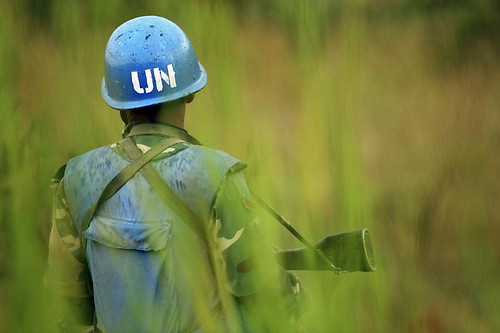
The disaster in the Democratic Republic of Congo continues unabated, and, as expected, the UN is moving to withdraw the controversial MONUC peacekeeping force. The short version of the story is that Congolese President Joseph Kabila is flexing his muscles, "requesting" the UN to leave. MONUC has long received mixed reviews, but the past year has been particularly difficult. Allegations of assisting brutal warlords and a general inability to affect change in the restive eastern provinces have plagued the UN, and the end appears nigh.
Contributing to the regional instability is the continued presence of the Lord's Resistance Army, which has migrated from it's birthplace in Uganda across the DRC, Central African Republic, and Sudan. Kudos to the New York Times for having an excellent reporter, Jeffrey Gettleman, there to cover the area (read his great piece on Somalia from 2009). Unfortunately he misses part of the story about the LRA.
 Labels:
Africa,
Bashir,
Central African Republic,
Dave Reidy,
DRC,
Jeffrey Gettleman,
Kabila,
LRA,
MONUC,
Somalia,
Sudan
|
Labels:
Africa,
Bashir,
Central African Republic,
Dave Reidy,
DRC,
Jeffrey Gettleman,
Kabila,
LRA,
MONUC,
Somalia,
Sudan
|
 0
comments
0
comments
Stay in the Loop!


 Posts
All Comments
Posts
All Comments
Our Favorite Blogs


.jpg)