When Robert Pape writes something on terrorism, I pay attention. He always adds something to the discussion, and usually it's something valuable. But his recent article on FP.com, "It's the Occupation, Stupid" delivers research results and leads the reader to an uncertain conclusion. His argument holds that terrorism, especially suicide terrorism, is motivated by foreign occupation. These findings, based on his research at the University of Chicago, make logical sense: of course people in an occupied territory resort to violence when all other means have been exhausted. His conclusion from this study, however, is problematic. Taking these findings to their logical end, Pape says
The research suggests that U.S. interests would be better served through a policy of offshore balancing.This is true, but interpreted incorrectly can lead to a dangerous isolationism. Pape is right that the War on Terror is self-defeating, and that having boots on the ground overseas can often be counterproductive. He is also right that occupying foreign territory provokes deadly blowback. But there are two important nuances to this argument:
1) Avoiding foreign occupation is not the same as withdrawing into isolation
2) Offshore balancing requires U.S. involvement and action in foreign countries, which could also instigate blowback.
First, it is important to recognize the difference between offshore balancing and isolationism. It is tempting to extrapolate from Pape's argument that retreating into "Fortress America" is the wisest course. But withdrawing from the world would not make America safer, and furthermore, in this global age, is impossible.
Secondly, offshore balancing implies U.S. power projection overseas and involvement in the affairs of other states, and that doing so is in the best interests of Washington. This could take the form of drone strikes, Special Operations raids, or even 1990's-style cruise missile attacks. But this involvement could have a similar effect as foreign occupation: motivating terrorists. This is a hole in Pape's data, and until further investigated remains a concern.
There is no question that Pape's overall point is correct: foreign occupation is a major driver of terrorism, and removing boots from the ground is preferable. But he would be wise to avoid leaving open the possibility of interpreting his findings to support isolationism.
 Labels:
Afghanistan,
Dave Reidy,
Iraq,
occupation,
Robert Pape,
suicide terrorism,
terrorism
|
 2
comments
Yes it's true, yet strangely you don't see that headline splashed across CNN. The reason is that this wasn't a conventional attack on Iran, it was a cyber attack. As David Sanger reported in the New York Times,
The Iranian government agency that runs the country’s nuclear facilities, including those the West suspects are part of a weapons program, has reported that its engineers are trying to protect their facilities from a sophisticated computer worm that has infected industrial plants across Iran.In short, a computer worm has infiltrated the systems that run Iran's nuclear facilities, causing an unspecified amount of damage. As the story reports, experts (and I am certainly not one) believe the level of sophistication of the attack could only be achieved by a state. Without further information about the extent of the damage or nature of the worm, which given the nature of attack is unlikely to be made public, it's impossible to say for sure who released the worm or why, but early speculation points at two prime suspects - Israel and the United States.
Attacking the technological base of the Iranian nuclear program is not a solution to the problem, but it will most likely slow the program. While that may seem minor, if you believe Jeffrey Goldberg's recent article in The Atlantic then perhaps a bit of time may be tremendously important.
Even more important, however, will be the repercussions from this attack. If Iran believes that the U.S. or Israel was behind the attack, it may seek to retaliate, in cyberspace or with a conventional attack. Furthermore, if other nations, particularly China and Russia, come to believe that America was behind this attack, it could mark the start of a new era of cyberwar. Until now countries have tested defenses and capabilities, much like boxers circling the ring and throwing exploratory jabs. Launching a prominent attack on Iran's nuclear systems could come to be viewed as the first real punch thrown in this match, and could signal to other powers that the fight is on.
Once that barrier is crossed, and cyberwar crosses from potential to actual, there is no going back.
Well summer has finally ended, and I have no choice but to accept the unfortunate reality that school is beginning yet again. On the plus side, now that I've returned to academia and a somewhat-normal routine, I'm set to resume blogging regularly (or at least less-irregularly). To kick things off, here is a response to Dan Drezner's post about how millennials understand foreign policy. Jeremy wrote a terrific response last week, and so I'm going to expand upon some of his themes and explore a few new ones.
I see two major points in this discussion:
1) We are not isolationist, instead we are globalized to an unprecedented degree.
2) We are cynical of how the world works, but that is not always a bad thing.
The most important point, contra-Drezner, is that our generation is not going to be "anti-interventionist to the point of isolationism." Instead, as Jeremy noted, this generation is truly the first "globalized generation." In terms of foreign policy, this means that we understand the inherent interconnectedness of today's world. Every individual across the globe could potentially impact our lives here, as the 9/11 hijackers proved, and as we increasingly rely on the internet for all aspects of our daily lives our vulnerability too grows. This is the bitter fruit of economic globalization and the revolutions in communications, travel, and technology that have changed the fundamentals of our existence.
Furthermore, we millennials understand that there is no going back. We cannot retreat to "Fortress America" and choose isolation; for seclusion is no longer an option. There are two reasons for this - structural and personal. Structurally, I find it hard to believe that the world will stop "shrinking" anytime soon. Communications technologies are constantly growing more powerful, and as the global economy continues to integrate it pulls the world inextricably together. We no longer manufacture everything in America that we need to survive, and the oceans of the world no longer serve as protective barriers against foreign intrusion. America is part of this global system, and millennials understand that taking our ball and going home simply no longer applies.
On the personal level, globalization, however you choose to define it, has taken root amongst our peers. Many millennials have traveled, studied, lived, and worked overseas, and not solely in Old Europe. We are fortunate to have these opportunities, made possible by the decrease in time, barriers, and, most importantly, cost of international adventure. The factors that enabled us to travel more than any previous generation are not going away, nor are the connections we made to people, places, and cultures. In other words, we millennials have a greater understanding of the globe than our predecessors, and a vested interest in places that is impossible to otherwise replicate.
The second major point concerns our relationship with governments, our own and foreign, and the international system. We are, to put it mildly, cynical. The distortions and lies of the Bush Administration regarding Iraq headline the list of grievances, but struggling through the Great Recession while watching Congress dither is only slightly less influential. Thanks to the miracle of the internet we have witnessed the prevarications of other governments and the ways in which they manipulate their own people.
This cynicism is not necessarily a bad thing. Our eyes are open to the ways of the world, and we are prepared to analyze the events of the future, not simply accept what we are given. And this doesn't mean that idealistic optimism is dead - we millennials have our fair share of dreamers, planners, and changers. But we do recognize the difficulties of achieving real, substantive, enduring changes, and come prepared.
Drezner's post is laced with pessimism for the future, and Jeremy is fueled by anger and frustration from our experiences. I don't share these views, but, like Jeremy, I am cautiously optimistic about the chances for our future. The interconnected world presents evolving threats, and it will require intellectual rigor, pragmatic flexibility, and a clear vision to meet these new challenges. I have faith that we millennials are prepared for what comes next.
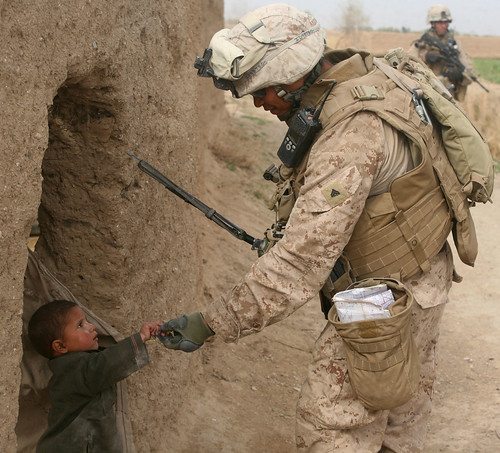
The always-superb Rajiv Chandrasekaran has a story in the Washington Post about progress in Afghanistan, comparing the lack of it in Marja (a "bleeding ulcer," as General McChrystal famously said) with the relative tranquility and prosperity of Nawa. Both hamlets are similar demographically and geographically, but while Marja continues to hemorrhage Nawa is creeping forward.
Both were stricken by the Taliban insurgency four years ago. And over the past year, both have been treated with America's new counterinsurgency formula: Each community has been flooded with U.S. Marines and Afghan security forces, at troop levels that meet or exceed what counterinsurgency theorists prescribe. Each has received a surge of cash and civilian experts in an effort to provide public services, rebuild infrastructure and dole out basic economic assistance. Each has been described as a priority by the central government in Kabul. So why did all this work in one but not the other?
 |
| Photo by Lance Cpl. Tommy Bellegarde |
Unfortunately, this is the wrong question. It rests on the assumption that the U.S. did something right in Nawa but something wrong in Marja, and the only thing to do is discover that error. At a deeper level, the assumption is that all events are conclusively influenced by U.S. policy - we can do it right or do it wrong, but ultimately we are the ones determining the outcome. I find this idea troubling. Accepting that the U.S. military is the decisive factor in the near-term future in Afghanistan means neglecting local relations and politics, national governance (or the lack thereof), and a host of other factors, not the least of which is the most fundamental of all military strategy - the enemy gets a vote.
Chandrasekaran almost hits on this point, but quickly loses the thread:
But the residents also emphasized that the Taliban fighters left of their own accord. "They chose to flee from here," said one shopkeeper. "They drove away as soon as the Marines arrived."In other words, perhaps the success in Nawa was not the result of superior American tactics, but rather of a Taliban miscalculation. Their failure in Nawa may have been part of the reason the Taliban refused to flee Marja; an attempt to avoid repeating the mistake.
So what does this mean for U.S. operations in Afghanistan? It's a reminder that actors and events that are not part of the plan influence the outcome, sometimes decisively. As the Bush Administration learned in the aftermath of the fall of Baghdad, unplanned events occur and must be dealt with, even if that means discarding the original blueprint. COIN doctrine cannot be implemented according to any book, and the notion that there is a "right" way to do COIN which guarantees success is a fallacy. Perhaps General Petraeus has taken a similar lesson from recent events. He has reportedly decided to scrap the invasion Kandahar, calling the current plan "not an appropriate model." Kudos to P4 for making the right call, and hopefully this is only the first of many.
Labels:
Afghanistan,
COIN,
Dave Reidy,
General Petraeus,
governance,
insurgency,
Marjah,
Nawa,
Rajiv Chandrasekaran
|
1 comments
While we've been distracted by the ever-changing world around us and lost interest in Iran after sanctions were passed by Congress, life has rolled on in Tehran. But it has not rolled smoothly. Yesterday marked a crucial turning point in domestic relations, as merchants in the capital ended a 12-day strike.
Now why is this important? No, it's not the result of U.S. sanctions and is certainly no reason to declare a victory. And no, these strikes really are not similar to the mass protests and strikes of 1979 that brought down the Shah - the government is in no immediate danger of collapsing. But this strike is crucially important as an indicator that economic conditions in Iran continue to deteriorate and that the general populace has thus far been unswayed by the "Blame America" rhetoric from the regime.
Under the mismanagement of President Ahmadinejad, the Iranian economy has cratered. He spun profits from record-high oil prices into vast subsidy programs to bulwark domestic support, but when oil prices dropped those programs became massive government expenditures with no revenue backing. Not only did he miss an opportunity to expand and diversify Iran's economy, Ahmadinejad's fiscal cluelessness has now burdened the state with more debt than it can handle. The solution: higher taxes, which led directly to the recent strike.
Again, the regime is not in imminent danger. But these strikes illustrate the cost of financial imprudence, and without an economic turnaround even blatant vote-stealing won't keep the current government afloat.
I'm a bit late weighing in on this absurd Russian spy saga, but I still don't quite know what to make of it. Originally, I was surprised that the arrests were made immediately on the heels of an apparently successful meeting between Obama and Medvedev. However, given that Moscow has, surprisingly, not issued a sharp rebuke of the U.S., I can only surmise that they either had advance warning or realize that the proof against these alleged agents is undeniable and it would only make them look worse to attempt a denial.
Interestingly, it seems that a massive prisoner swap is in already set to be completed. Not much information is available about who will be exchanged, but it seems plausible that Washington seized these agents solely to use as trade bait in order to regain U.S. assets in Russian custody. More importantly, the whole affair reminds me of the wise words of the late, great, Warren Zevon: "how was I to know she was with the Russians too?"
And if you think this whole post was just an excuse to include such an epic video, well you might be right...
Emily Keane
Kampala, Uganda
In response to Dave Reidy’s post on Nicholas Kristof’s article on conflict minerals in the DRC, I strongly believe that Reidy’s attack is deeply flawed. As I see it, Reidy’s main point is to lambaste Kristof for his uninformed, simple description and solution of a conflict that United States consumers cannot solve.

Why must we claim that a commitment group of people cannot influence change?! Sure, American consumers are idealistic and have the attention span of a fly, but their power CAN be harnessed! Worldwide pressure against South Africa's policy of apartheid played a role in its banishment. There's are more than enough examples to use here, but just look at Kristof’s first sentence: ''“Blood diamonds” have faded away, but we may now be carrying “blood phones.” Perhaps a bit kitschy, but no one would argue that only years ago the idea of combating conflict diamonds was considered impossible. And look how far we've come on that issue! Do they still exist? Yes. But now a majority of people have the facts and have the ability to make a more ethical decision when buying diamonds. Why is it any different with the natural resources in Congo?
I completely agree with Reidy that the conflict in the Congo and its associated economy is complex. But to scoff at Kristof’s suggestion that a more well-informed public will not change anything is too pessimistic for me. Kristof’s solution will perhaps, at best, only put a small dent in the conflict, but is that not something?
Of course, this will not solve the conflict and only locally stakeholders committed to peace can achieve that. Kristof’s article offers food for thought on what we can do for those affected by this conflict: to be more aware and thoughtful in our choices as consumers.
Emily Keane is a joint-degree student at the Fletcher School of Law and Diplomacy at Tufts University and Massachusetts Institute of Technology focusing on humanitarian logistics
Nick Kristof has another column out this week on the DRC, highlighting the role of "conflict minerals" in the ongoing violence.
I’ve never reported on a war more barbaric than Congo’s, and it haunts me. In Congo, I’ve seen women who have been mutilated, children who have been forced to eat their parents’ flesh, girls who have been subjected to rapes that destroyed their insides. Warlords finance their predations in part through the sale of mineral ore containing tantalum, tungsten, tin and gold. For example, tantalum from Congo is used to make electrical capacitors that go into phones, computers and gaming devices.This, sadly, is true: the conflict in the DRC is horridly brutal and violent, and some of the belligerents do derive funding from mining these minerals. Kudos to Kristof and the ENOUGH Project, under the leadership of John Prendergast, for calling attention to the horror unfolding daily.

Unfortunately, the plaudits for their efforts end there, as their narrative of the conflict is one-dimensional and unrealistic. Bringing pressure to bear on companies like Apple is a good thing, but it's nothing more than symbolic and will ultimately be impotent to halt, or even alter, the carnage in the Congo. Kristof acknowledges that combating conflict minerals alone is insufficient,
It’s not that American tech companies are responsible for the slaughter, or that eliminating conflict minerals from Americans’ phones will immediately end the war. Even the Enough Project, an anti-genocide organization that has been a leading force in the current campaign, estimates that only one-fifth of the world’s tantalum comes from Congo. “There’s no magic-bullet solution to peace in Congo,” notes David Sullivan of the Enough Project, “but this is one of the drivers of the conflict.” The economics of the war should be addressed to resolve it.but he doesn't go far enough. There are two problems with the notion that public pressure can change events.
First, as Kristof mentions, conflict minerals are not the main driving force behind the violence.
The drumbeat of support for harsh sanctions against Iran continues, this time in a featured article from
Sanctions helped South Africa's pro-democracy movement. They can do the same in Iran.Really? They did? Because I seem to recall that the sanctions against South Africa were economically pathetic and insignificant. They had value as a message from the international community, but the meat of the sanctions did little. In fact, the ban on arms trade with South Africa, one of the core components of the sanctions regime (along with oil), had the perverse effect of transforming South Africa into one of the largest and most sophisticated arms manufacturers in the world (see Crawford and Klotz for details).
And oil, the second primary focus of the sanctions regime, continued to flow freely. Smuggling was rampant, and many states chose to defy the will of the international community to exploit a lucrative market. Ironically, Iran was the main player to do so (see Klinghoffer for more). In short, the international embargoes on goods had little effect on the apartheid regime, and certainly did not "marginalize and undermine the government" as
Mohsen Makhmalbaf, a filmmaker, to substantiate this claim. Unfortunately, all other supporting claims are from "a growing number of key opinion-makers and activists in the green movement," "other Iranian dissidents and activists," and "Iranian experts and analysts" - an impressive list of anonymous sources. I understand that personal security is a factor (nobody wants a knock on the door from the basij), but constructing an entire argument on nameless sources is poor analysis, especially when you factor in their dismissal of Mir Hossein Mousavi and other leaders speaking out against sanctions for "for what appear to be tactical reasons." So the opinion of Mousavi, who was the face of the Green Movement and actually stood for office, can be summarily dismissed, but the thoughts of anonymous "dissidents and activists" are grounds for robust sanctions.
Puzzlingly, the authors paint China and Russia as complicit in Tehran's pillaging of natural resources, yet do not recognize that sanctions are meaningless without full international cooperation. The U.S. could pass harsh unilateral sanctions on Iran, and would most likely be supported by many European allies. However, if Russia and, even more, China, could undermine any sanctions simply by continuing to trade. The growing energy appetite of China and Russian refinement capabilities could comfortably offset the loss of trade from the U.S. and Europe. In other words, the Obama Administration is constrained in what it can do, something the authors fail to recognize.
Harsh sanctions are not the answer in Iran. The risk of playing into the hands of Tehran's hardliners by acting as "the Great Satan" is high, and the potential payoff is low, especially without full international support. More troubling is the idea that the authors speak for "Iranians who yearn for democracy," yet fail to produce a shred of proof that the disparate members of the loosely-affiliated Green Movement would welcome international sanctions. Dubowitz and Weinthal, and Slate, should know better.
I wasn't able to attend in person, but I did manage to watch a bit of the proceedings from today's conference at CNAS. They had a great cast of presenters, headlined by Michèle Flournoy, Under Secretary of Defense for Policy (and rumored successor to Bob Gates as SecDef) giving the keynote.

The basic premise, that the U.S. military was ill-prepared for the wars they are currently fighting, is sound. As is the underlying assumption, that these wars (call them small wars, hybrid, 5th generation, whatever) will be the most prevalent forms of kinetic conflict in the future. What concerns me is that fighting these wars is only possible because of American hegemony in traditional warfare. In other words, the U.S. ends up fighting small/hybrid wars/insurgencies because their dominance in all other aspects of warfare means that nobody is willing to even mount a challenge. But, if a majority of resources are shifted away from conventional operations, that could potentially leave the U.S. military open to a challenge from a near-peer rival (the most obvious candidate being China).
I'm not the first person to suggest this danger; in fact I think this places me firmly with the majority of military analysts. Nor am I pressing the panic button: I don't think this scenario is likely, and I think Gates/Flournoy are smart to seek an increase in the U.S. irregular/hybrid capabilities. But it's important to be cognizant that the pendulum can swing too far the other way and avoid becoming enamored with the latest and greatest in technology and strategy.
I wasn't planning to comment on the recent events involving Israel and the flotilla of humanitarian aid. The event has received saturation media coverage and, as an expert neither on the Middle East nor international law, I didn't feel I had anything new or valuable to contribute. However, readers have requested we address the topic, so I have no choice but to bow to their wishes (the customer is always right!) and add my two cents.
First of all, the fact that this ended with multiple deaths is tragic and was utterly avoidable. I'm not adequately equipped to wade into debate over the legality of Israel's actions, so I'll hold my tongue - but do check out the excellent discussion taking place over at Opinio Juris.
I do, however, feel sufficiently qualified to share the sentiments put forward by Stephen Walt and Dan Drezner - what the f*** were the Israelis thinking? They had to understand that this overreaction would have overwhelmingly negative consequences for them, and that having commandos forcibly board would inevitably lead to bloodshed. As the ever-astute Jon Stewart put it, perhaps those on board the ship thought the Israelis were greeting them with "commando-shaped pinatas." (Clip starts at 3:45)
| The Daily Show With Jon Stewart | Mon - Thurs 11p / 10c | |||
| Clusterf#&k to the War House - Korean Peninsula & Middle East | ||||
| ||||
Furthermore, I am disappointed in the response from the Obama Administration, which refused to condemn the incident and watered down the UN Security Council statement. The Administration could potentially use this tragedy to bring about meaningful change in Israel, by privately pressuring Netanyahu to make serious concessions while publicly protecting the Israeli government to offer political breathing space. That would be a delicate balancing act, and unfortunately I have yet to see any evidence to support that theory.
In addition to not being qualified to debate the legality of the incident, I also think that discussion is a bit of a sideshow. This was not an isolated incident; it is symptomatic of and caused by the long-standing Israeli-Palestinian deadlock. Immersing ourselves in the minutiae of international law may be missing the forest for a single tree, because the relevant issue isn't this incident, it's the situation as a whole. There can be no resolution to this tragedy nor a way to prevent future iterations without a comprehensive peace process, involving and satisfying all relevant parties.
Perhaps the fallout from this shoot-out will be the catalyst for breaking the decades of regional stalemate. But the overall situation is static: the Netanyahu government remains intransigent, Hamas refuses to recognizes Israel's right to exist, regional governments use the issue as a soapbox to enhance their "pro-Muslim" and "anti-West" credentials among their own radicals, and pro-Israel groups in America retain their influence. I'm not holding my breath for change.
Apparently the nothing I discussed is actually substantial enough to draw attention from militants, who attacked the jirga proceedings yesterday. In a perverse way, this is a positive sign for Karzai. Empty talks pose no threat to the Taliban, and therefore are unlikely to prompt a response. But a concerted attack indicates that they view the jirga as a threat. In a strange way, this attack serves to increase the legitimacy and potential of Karzai's peace talks.
I remain skeptical that the Afghan government will actually implement any governance improvements, but having a peace jirga attacked by militants is a twisted victory in the public information war.
The BBC has a question: can a jirga without rebel leaders bring Afghanistan peace?
The answer, obviously, is a resounding no. Duh.
But if the jirga is a kind of peace conference, it is rather one sided. The insurgents' leaders are not there. Hizb-e-Islami, a small militant group which has sometimes fought with the Taliban, said the jirga was of "no importance". "The participants of the jirga are state favourites," said a statement released by the group. "They have no power of decision. It is only a consultative jirga - without any participation of the Mujahideen."So what's going on with Karzai? Clearly the U.S. is backing this initiative, but only tepidly. The Embassy released a statement of support, but the process hasn't been emphasized by any of the leading American policymakers, most notably McChrystal, Holbrooke, and Clinton. NATO is in favor as well, but let's be honest: this jirga is nothing but empty talk. Karzai and Co. can continue talking the talk of governance and reconciliation, but without clear results, real progress, changes will not be forthcoming. And if we've learned one thing about Karzai over the past (almost!) decade, it's that he is willing to talk nice, but not follow through.
Well, let's just say I think it's unlikely. Tensions are high, and the North's provocative sinking of a South Korean warship requires a response. But what should that response be?
War is out of the question, at least from the American and South Korean side. North Korea could, if open hostilities commenced, inflict not-inconsiderable damage on the South, particularly Seoul, and possibly on Japan as well. A war would also have a destabilizing effect on the entire region, and could prompt a massive refugee crisis that all states, especially China, would like to avoid.
And what of sanctions? Well there really aren't many sanctions available to the international community that aren't already in place. Pyongyang has persevered under a myriad of sanctions over the years, with little discernible change in policy, and that option seems exhausted, save as a gesture of international condemnation.
So what can be done? Not much, it appears, unless South Korea, the US, China, Japan, and the UN Security Council agree to mount a large-scale invasion and regime-change operation. Needless to say, the odds of that happening are slightly smaller than winning the Powerball.
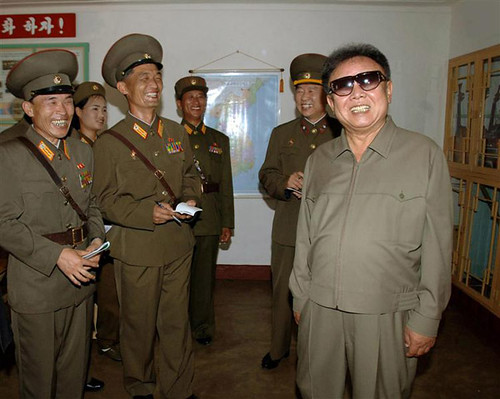
I believe the more pressing concern is about motivation - why did Kim Jong Il choose to attack a South Korean warship? I'm no expert on North Korea, but it seems to be an attempt to maintain his "irrational actor" status. If you accept that he is irrational, potent options - such as limited military strikes or more robust targeted sanctions - must be shelved under the notion that they may cause him to overreact, possibly with nuclear weapons. I think he is an eminently rational actor, interested solely in maintaining power and ensuring the succession of the family dynasty. If that is his goal, acting like a crazy person to keep the rest of the world off-balance is actually not so crazy. However, calling his bluff with surgical strikes is an extremely dangerous gamble with little upside.
The other key consideration is China. Beijing has been North Korea's most ardent supporter, and Chinese food aid nourishes many North Koreans. China fears the after-effects of a destabilizing regime change, with refugee flows across the border causing domestic upheaval. Kim Jong Il took a recent "secret" trip to China, and while the full contents of his conversations are not public it's safe to assume that the sinking of the Cheonan was on the agenda. As usual, China holds the balance of power and can influence the direction of future talks.
My prognosis: nothing. The Security Council may pass a few additional impotent sanctions, and South Korea will verbally lambaste the North, but no concrete action will be taken. Eventually the six-party talks will resume, with the status quo unchanged.
William Dalrymple is one of my favorite writers. City of Djinns, The Last Mughal, and White Mughals are among the finest sources available on the history of India, and From the Holy Mountain is an intellectual travelogue, blending the ancient and modern Middle East. But his recent op-ed in the New York Times, The Ghosts of Gandamak, is a disappointment. Dalrymple's sense of history and lively narrative ability are abundant, but his decision to abuse the tired trope about Afghanistan's invulnerability to conquest is a waste.

This story is sadly easy to believe. However, its relationship with the 1842 massacre is unclear. Dalrymple attempts to draw the lesson that military solutions alone are inadequate; if that's the status of the enlightened discourse about the Afghanistan campaign we are all in dire straits. That a political initiative is needed is apparently to all non-comatose observers, and although Dalrymple's advice to negotiate with the Taliban may be correct, it is in no way supported by his historical analogy.
I find it infuriating when a discussion of strategy in Afghanistan is hijacked by the fallacy that it is an inherently ungovernable zone. This position invokes the argument Seth Jones made when writing In the Graveyard of Empires: that would-be conquerors, from Alexander the Great through the British Empire, met their downfall in the mountains and valleys of Afghanistan at the hands of fiercely independent natives. The only lesson that can be learned from this teleological reading of history is to avoid Afghanistan at all costs, because forces sinister and free lurk to thwart the aspiring invader.
This notion, to be charitable, is rubbish. Afghanistan is difficult to govern because of its vast size and rugged terrain, but it is scarcely the only inhospitable ground on earth. It is no more or less difficult to control than any topographically similar area. Relying on this simplistic formulation to explain contemporary events dangerously obscures important factors and places undue emphasis on irrelevant areas.
There is value in Dalrymple, but it has nothing to do with the failings of the British or events of 1842. Instead, his tale should serve as another reminder of what we already know: no measure of success is possible in Afghanistan without good governance from Kabul; but all parties are falling drastically short in that metric. A failed 19th century British invasion holds no explanatory power nor relevant information about the continuing failure of President Hamid Karzai to provide basic services or tackle corruption, and that is the point which matters.
We seem to have sparked a debate here about the LRA, and I invite everyone to contribute. This is a complex issue fraught with implications for human rights, sovereignty, and regional politics, and I think it would behoove us all to carefully unpack and analyze each component.
To begin with, commenter "Caroline" raised some excellent points about the desirability of a military approach and other alternatives, and I would like to highlight her thoughts and respond to here.
Caroline:
Dave, Thanks for writing about this important topic on your blog. I generally agree with your arguments here but have to disagree on a few points.
First, you say "America has the power to catch Kony, but not the will." I agree with you that the US will never deploy troops to capture or kill Kony. No matter how many human rights organizations jump up and down decrying the abuses of the LRA, the US will never deploy troops to capture or kill Kony. I am less certain, however, that the US actually has the power to do so -- effectively. Granted, I am not an expert on the tactics and capabilities of US Special Forces, but if faulty US intelligence was one of the reasons why the attack on Kony in December 2008 failed so catastrophically, I am not confident that the US is the best candidate for capturing him. In order to carry this out, the US would have to spend a significant amount of time gathering intel on a region of northeastern Congo and southeastern CAR that I am almost certain they are not familiar with. I highly doubt the US would commit Special Forces to spend the required amount of time gathering this intel if they did decide to launch an operation. And if they don't gather the intel, the operation will no doubt fail. Again.
This leads me to my second point. I believe discussing the military option surrounding the LRA is not a constructive debate. Neither the US nor the EU will commit the time or troops needed to capture Kony, so any operation they launch would likely fail. Continuing the debate on the military option, in my opinion, is not the direction the debate should be going. I realize there are strong vested interests in Uganda that encourage this debate, but it is a dangerous one. One glance through the Human Rights Watch reports on the consequences of the December 2008 operation should lead readers to understand that pursuing this route is both foolish and highly irresponsible given the civilian costs.
What then is the solution? I don't have an easy one. I would advocate for a return to the negotiating table, an increase in MONUC deployments (with contingents ready to use force to defend civilians) to areas at risk from LRA attack, an increase in Ugandan and possibly Rwandan deployments to Obo in CAR, and strong US, EU, and AU pressure on Khartoum to stop its recently renewed support to the LRA. All of these efforts should be focused on the protection of the civilian population, not on killing Kony. Pursuing the military option is entirely irresponsible and disregards the reality of civilian life that is lost in its wake.
Thanks in advance for considering my comments.
First of all, thanks for reading. You make some insightful and important points, and I think you and I agree on most aspects here.
Your first point, about the necessity of good intel to catch Kony, is absolutely true. It's one of the many reasons I believe the U.S. won't become more heavily involved. As you point out, gathering intel requires personnel, time, and money, and I don't believe the Obama Administration is prepared to commit those resources for a sustained effort. The difference between the U.S. and the regional governments is in capacity. The U.S. could put together the required intel if so inclined, whereas the Ugandan, Congolese, Sudanese, and CAR governments simply don't have the ability to undertake such a large, complex operation.
Your second point is also quite astute - I agree that the military option holds little promise so long as the US and EU are not willing to commit. Not only is the military option unlikely to catch Kony, but it also comes with severe human rights consequences, as you point out. This unfortunately is not a new aspect to the campaign against the LRA; the Ugandan military was responsible for despicable human rights violations in northern Uganda when pursuing Kony.
I disagree, however, with your conclusions.
In case you're just tuning in, a few weeks ago Michael Wilkerson wrote a piece for FP entitled "Why Can't Anyone Stop the LRA." I quibbled with a few points, and wrote up my objections here on D&D. Michael got wind of my response and wrote a supremely cogent rebuttal on his own blog, at which time the sheer hell of finals derailed me from ever posting a response. Here, slightly belatedly, is my answer (could we call it a re-re-response?).
While it's tempting to allow this to degrade into a snarky blog-war, (because, let's face it, that's fun) I prefer more serious analysis, and in fact Michael and I agree on most points. And even where our opinions differ, I wouldn't say we disagree so much as we have slightly different interpretations.
We agree (and Michael, please correct me if I err here) that the regional governments, South Sudan, CAR, and DRC, are extremely weak. Michael notes that "regional governments are working together - at least on paper" and I agree, and it seems as though we concur in our analysis that this coordination is, practically speaking, essentially worthless.
We also share the belief that if the U.S. was seriously committed the LRA would soon be eliminated. He has a great line here about the level of American commitment:
But that’s akin to saying if Congress really wanted to balance the budget it would eliminate corn subsidies. There may be a lot of truth there but that doesn’t put it very far within the realm of political possibility.I agree wholeheartedly here; and Michael I would like to eventually discuss the merits of the increasing U.S. military presence in Africa. My point in raising the specter of greater U.S. involvement in the chase for Kony is to critique those very factors that make it an infeasible outcome - America has the power to catch Kony, but not the will, and this must be considered among the sad reasons the LRA is still at-large.
But we do have our disagreements. At the end of his rebuttal, Michael objects to my characterization of the Ugandan forces as "rag-tag" and points to the presence of former LRA fighters in their midst to substantiate his point. I respectfully disagree. Perhaps the term "rag-tag" is altogether too vague. I take the point that these are not bottom-of-the-barrel troops - certainly these Ugandan units are superior to their Congolese colleagues. And they appear to be better behaved than other branches of Ugandan military, which committed innumerable human rights violations in the campaign to chase the LRA from Uganda. The Gettleman article Michael cites even quotes a representative from Human Rights Watch praising their behavior, a welcome change from the past.
But talk about damning with faint praise - those are some weak comparisons. Militarily, perhaps the best way measure of the competence of the Ugandan troops is to look at their results, and they are not positive. Kony is still roaming free, and reportedly has popped up everywhere from the DRC to Darfur. And even with logistical aid from the U.S., as Michael touts, and intel contributions prior to Operation Lightning Thunder, they have been unable to corral Kony.
This is where Michael and I differ most sharply, though on a theoretical rather than practical level. I believe that part of the reason the LRA remains at large is a failure to accurately conceptualize and analyze them as an organization. The LRA lacks serious political goals (Kony occasionally pays lip service to the idea of ruling Uganda, but his actions belie that goal). Nor do they have the support of the populace, on ethnic or ideological lines, to conduct a classic Maoist Peoples War. But, on the other extreme, they don't seem to be engaged in criminal trafficking except to support their own existence. In short, who the hell are the LRA? If they aren't traditional insurgents or guerrillas, but they aren't criminals, who are they?
This is not simply an academic question. How can you effectively target a group if you don't understand their motives and goals? Overlooking the nature of the LRA is one of the reasons Operations Lightning Thunder was such a spectacular failure. The Ugandan military (and, presumably, their U.S. supporters) were stuck in the old RMA mindset about the superiority and universal applicability of air power. The massive bombing raids that characterized the operation would have been appropriate for the skies over Nazi Germany, but not for finding and eliminating a small group of fighters. New enemies call for new tactics, and that lesson has gone unheeded.
There is some promise of innovation in the Ugandan's use of former LRA members as trackers, but it is an incredibly risky move and I think it also speaks to the paucity of ability among Ugandan units. I have seen no coherent attempts to understand the existence of the LRA as anything but a band of cult killers and their brainwashed followers. Even if that is their raison d'etre, there needs to be some work done on utilizing that information to form a coherent strategy. Simply hunting Kony across such a vast area with little idea of where he will go next, or why, is an awfully tall task.
I don't pretend to know how to understand the LRA, and so I'll bounce that (possibly impossible) question back to Michael. But I do think it's important to become familiar with the enemy, otherwise any strategy risks being misguided.
In the final tally, Michael and I seem to see eye-to-eye on most aspects of the LRA. But, Michael, what do you make of the LRA, and can we use that information to better formulate a strategy for stopping them?
Apologies to all for my absentee blogging. I'd like to come up with a detailed and sophisticated explanation, but quite simply finals are kicking my ass and I have no free time to sleep, let along blog.
I have quite a list of topics to tackle, starting with my long-overdue response to Mike Wilkerson about the LRA and some thoughts on the latest RAND study. With any luck I'll be back in the flow next week.
Until there, here are is a bizarre, insane, and utterly fascinating Vanity Fair story about a born-again American Hells Angel, roaming Sudan and trying to kill Joseph Kony.
I have just returned from an exhausting weekend in the woods as a participant in the 2010 Harvard Humanitarian Initiative field simulation. It was quite a weekend, and between conducting rapid assessments on refugee camps and being ambushed by "militia" I didn't have much time for anything else.
In the next few I days I hope to catch up on the news (and my sleep), and I'm starting with a new report from RAND - How Insurgencies End. I'll check back in when finished. Anybody out there with thoughts on this study?
Yesterday the Taliban killed the deputy mayor of Kandahar, Azizullah Yarmal. He was apparently was widely regarded as an honest and effective leader, unlike most of his colleagues. As Spencer Ackerman notes, this is clearly a setback to U.S. goals, as after the planned summer offensive in Kandahar providing good governance will require dedicated civil servants like Deputy Mayor Yarmal.
However, there is a silver lining. The method the Taliban used to kill the deputy mayor was quite brutal, even by their standards.
Deputy Mayor Azizullah Yarmal walked into a mosque in central Kandahar, turned toward Mecca and began to pray. As he reached the point where he and the others in the mosque knelt in unison and then bent forward to touch their foreheads to the ground, gunmen made their move, shooting him with a pistol, said Zalmy Ayoubi, a government spokesman.I haven't studied the issue in depth, but my understand is that assassinations in mosques are generally frowned upon. We know the Taliban is borrowing from the U.S. COIN manual, and killing a man while in the act of prayer generally serves to enrage, not please, the local population. This move smacks of desperation. If the Taliban in Kandahar must resort to mosque assassinations, I would hazard a guess that they are back on their heels and struggling to achieve their aims.
It will be interesting to follow reports from the area and see if this event does indeed represent a Taliban overreach, and, much like happened to Zarqawi in Iraq, the violence becomes too much for residents to bear.
Stay in the Loop!


 Posts
All Comments
Our Favorite Blogs


