Nick Kristof has another column out this week on the DRC, highlighting the role of "conflict minerals" in the ongoing violence.
I’ve never reported on a war more barbaric than Congo’s, and it haunts me. In Congo, I’ve seen women who have been mutilated, children who have been forced to eat their parents’ flesh, girls who have been subjected to rapes that destroyed their insides. Warlords finance their predations in part through the sale of mineral ore containing tantalum, tungsten, tin and gold. For example, tantalum from Congo is used to make electrical capacitors that go into phones, computers and gaming devices.This, sadly, is true: the conflict in the DRC is horridly brutal and violent, and some of the belligerents do derive funding from mining these minerals. Kudos to Kristof and the ENOUGH Project, under the leadership of John Prendergast, for calling attention to the horror unfolding daily.

Unfortunately, the plaudits for their efforts end there, as their narrative of the conflict is one-dimensional and unrealistic. Bringing pressure to bear on companies like Apple is a good thing, but it's nothing more than symbolic and will ultimately be impotent to halt, or even alter, the carnage in the Congo. Kristof acknowledges that combating conflict minerals alone is insufficient,
It’s not that American tech companies are responsible for the slaughter, or that eliminating conflict minerals from Americans’ phones will immediately end the war. Even the Enough Project, an anti-genocide organization that has been a leading force in the current campaign, estimates that only one-fifth of the world’s tantalum comes from Congo. “There’s no magic-bullet solution to peace in Congo,” notes David Sullivan of the Enough Project, “but this is one of the drivers of the conflict.” The economics of the war should be addressed to resolve it.but he doesn't go far enough. There are two problems with the notion that public pressure can change events.
First, as Kristof mentions, conflict minerals are not the main driving force behind the violence.
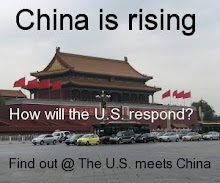
China's rise to great power status is moving along steadily, and US policymakers are acknowledging it publicly.
Secretary of Defense Robert Gates made the following comment at a June 16th Hearing of the Senate Appropriations Subcommitee on Defense (in response to a question about arms sales to Taiwan from Senator Dianne Feinstein):
And I was struck by an article in the local press in Singapore following that session. Somebody asked one of these Chinese generals or some Chinese general -- it may not have been one present -- "You guys have known about these sales for decades. Why all of a sudden are you raising such a stink about them?" And -- and this general's response was, "We had to accept it when we were weak. We are no longer weak."China has a long history of being pushed around by Western powers. It was "opened" by the British in the mid-19th Century (when the British acquired Hong Kong), and subsequently maintained as an open trading partner by force by various Western powers, including the US. As an underdeveloped country lacking economic and military power, China was (mostly) forced to accept the terms dictated to it by others.
Since China became the state we know today, it has espoused an ideology of "peaceful rising." In a nutshell, China knows it deserves a place among the great powers, but won't ruffle any feathers along the way.
Recently however, China has begun to assert itself. Its actions at the Copenhagen climate conference and its stance towards the sinking of the South Korean navy corvette Cheonan have alienated would-be partners, and have amounted to a policy that Daniel Drezner describes (diplomatically) as "Pissing Off as Many Countries As Possible."
Given this trend, how should the US address China today and in its future policies?
 Labels:
Beau Barnes,
China,
peaceful rising,
secretary gates,
Taiwan,
US foreign policy
|
Labels:
Beau Barnes,
China,
peaceful rising,
secretary gates,
Taiwan,
US foreign policy
|
 0
comments
0
comments
The long anticipated QDR has finally arrived and all of us security geeks voraciously downloaded it yesterday and stayed up to the wee hours of the morning pouring over its every word desperately searching for something resembling a coherent defense strategy. Unfortunately, there is not all that much new to report. The QDR reminds us that we are still actively fighting two wars and that essentially we can't really figure out a way forward until we somehow extricate ourselves from those debacles. To that I say "Don't we need to be thinking at least ten years ahead if we aren't going to be caught off guard." The following is a critique of the 2010 QDR, which despite my overall disappointment, does have a few new ideas scattered amongst it.
- CG(X) Cruiser
- C-17 Airlift Aircraft
- DDG 1000 Destroyer
- The Army's Future Combat Systems Program
- Delayed the new aircraft carrier
- Ended production of the F-22 Fighter
Labels:
area denial,
China,
Christine Wormuth,
COIN,
CSIS,
Hyrbid War,
Jeremy White,
QDR,
Quadrennial Defense Review,
strategy
|
1 comments
Stay in the Loop!


 Posts
All Comments
Posts
All Comments
Our Favorite Blogs


.jpg)