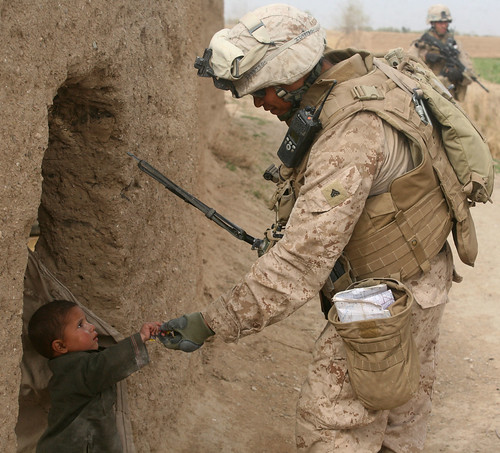
The always-superb Rajiv Chandrasekaran has a story in the Washington Post about progress in Afghanistan, comparing the lack of it in Marja (a "bleeding ulcer," as General McChrystal famously said) with the relative tranquility and prosperity of Nawa. Both hamlets are similar demographically and geographically, but while Marja continues to hemorrhage Nawa is creeping forward.
Both were stricken by the Taliban insurgency four years ago. And over the past year, both have been treated with America's new counterinsurgency formula: Each community has been flooded with U.S. Marines and Afghan security forces, at troop levels that meet or exceed what counterinsurgency theorists prescribe. Each has received a surge of cash and civilian experts in an effort to provide public services, rebuild infrastructure and dole out basic economic assistance. Each has been described as a priority by the central government in Kabul. So why did all this work in one but not the other?
 |
| Photo by Lance Cpl. Tommy Bellegarde |
Unfortunately, this is the wrong question. It rests on the assumption that the U.S. did something right in Nawa but something wrong in Marja, and the only thing to do is discover that error. At a deeper level, the assumption is that all events are conclusively influenced by U.S. policy - we can do it right or do it wrong, but ultimately we are the ones determining the outcome. I find this idea troubling. Accepting that the U.S. military is the decisive factor in the near-term future in Afghanistan means neglecting local relations and politics, national governance (or the lack thereof), and a host of other factors, not the least of which is the most fundamental of all military strategy - the enemy gets a vote.
Chandrasekaran almost hits on this point, but quickly loses the thread:
But the residents also emphasized that the Taliban fighters left of their own accord. "They chose to flee from here," said one shopkeeper. "They drove away as soon as the Marines arrived."In other words, perhaps the success in Nawa was not the result of superior American tactics, but rather of a Taliban miscalculation. Their failure in Nawa may have been part of the reason the Taliban refused to flee Marja; an attempt to avoid repeating the mistake.
So what does this mean for U.S. operations in Afghanistan? It's a reminder that actors and events that are not part of the plan influence the outcome, sometimes decisively. As the Bush Administration learned in the aftermath of the fall of Baghdad, unplanned events occur and must be dealt with, even if that means discarding the original blueprint. COIN doctrine cannot be implemented according to any book, and the notion that there is a "right" way to do COIN which guarantees success is a fallacy. Perhaps General Petraeus has taken a similar lesson from recent events. He has reportedly decided to scrap the invasion Kandahar, calling the current plan "not an appropriate model." Kudos to P4 for making the right call, and hopefully this is only the first of many.
 Labels:
Afghanistan,
COIN,
Dave Reidy,
General Petraeus,
governance,
insurgency,
Marjah,
Nawa,
Rajiv Chandrasekaran
|
Labels:
Afghanistan,
COIN,
Dave Reidy,
General Petraeus,
governance,
insurgency,
Marjah,
Nawa,
Rajiv Chandrasekaran
|
 1 comments
We seem to have sparked a debate here about the LRA, and I invite everyone to contribute. This is a complex issue fraught with implications for human rights, sovereignty, and regional politics, and I think it would behoove us all to carefully unpack and analyze each component.
To begin with, commenter "Caroline" raised some excellent points about the desirability of a military approach and other alternatives, and I would like to highlight her thoughts and respond to here.
Caroline:
Dave, Thanks for writing about this important topic on your blog. I generally agree with your arguments here but have to disagree on a few points.
First, you say "America has the power to catch Kony, but not the will." I agree with you that the US will never deploy troops to capture or kill Kony. No matter how many human rights organizations jump up and down decrying the abuses of the LRA, the US will never deploy troops to capture or kill Kony. I am less certain, however, that the US actually has the power to do so -- effectively. Granted, I am not an expert on the tactics and capabilities of US Special Forces, but if faulty US intelligence was one of the reasons why the attack on Kony in December 2008 failed so catastrophically, I am not confident that the US is the best candidate for capturing him. In order to carry this out, the US would have to spend a significant amount of time gathering intel on a region of northeastern Congo and southeastern CAR that I am almost certain they are not familiar with. I highly doubt the US would commit Special Forces to spend the required amount of time gathering this intel if they did decide to launch an operation. And if they don't gather the intel, the operation will no doubt fail. Again.
This leads me to my second point. I believe discussing the military option surrounding the LRA is not a constructive debate. Neither the US nor the EU will commit the time or troops needed to capture Kony, so any operation they launch would likely fail. Continuing the debate on the military option, in my opinion, is not the direction the debate should be going. I realize there are strong vested interests in Uganda that encourage this debate, but it is a dangerous one. One glance through the Human Rights Watch reports on the consequences of the December 2008 operation should lead readers to understand that pursuing this route is both foolish and highly irresponsible given the civilian costs.
What then is the solution? I don't have an easy one. I would advocate for a return to the negotiating table, an increase in MONUC deployments (with contingents ready to use force to defend civilians) to areas at risk from LRA attack, an increase in Ugandan and possibly Rwandan deployments to Obo in CAR, and strong US, EU, and AU pressure on Khartoum to stop its recently renewed support to the LRA. All of these efforts should be focused on the protection of the civilian population, not on killing Kony. Pursuing the military option is entirely irresponsible and disregards the reality of civilian life that is lost in its wake.
Thanks in advance for considering my comments.
First of all, thanks for reading. You make some insightful and important points, and I think you and I agree on most aspects here.
Your first point, about the necessity of good intel to catch Kony, is absolutely true. It's one of the many reasons I believe the U.S. won't become more heavily involved. As you point out, gathering intel requires personnel, time, and money, and I don't believe the Obama Administration is prepared to commit those resources for a sustained effort. The difference between the U.S. and the regional governments is in capacity. The U.S. could put together the required intel if so inclined, whereas the Ugandan, Congolese, Sudanese, and CAR governments simply don't have the ability to undertake such a large, complex operation.
Your second point is also quite astute - I agree that the military option holds little promise so long as the US and EU are not willing to commit. Not only is the military option unlikely to catch Kony, but it also comes with severe human rights consequences, as you point out. This unfortunately is not a new aspect to the campaign against the LRA; the Ugandan military was responsible for despicable human rights violations in northern Uganda when pursuing Kony.
I disagree, however, with your conclusions.
In case you're just tuning in, a few weeks ago Michael Wilkerson wrote a piece for FP entitled "Why Can't Anyone Stop the LRA." I quibbled with a few points, and wrote up my objections here on D&D. Michael got wind of my response and wrote a supremely cogent rebuttal on his own blog, at which time the sheer hell of finals derailed me from ever posting a response. Here, slightly belatedly, is my answer (could we call it a re-re-response?).
While it's tempting to allow this to degrade into a snarky blog-war, (because, let's face it, that's fun) I prefer more serious analysis, and in fact Michael and I agree on most points. And even where our opinions differ, I wouldn't say we disagree so much as we have slightly different interpretations.
We agree (and Michael, please correct me if I err here) that the regional governments, South Sudan, CAR, and DRC, are extremely weak. Michael notes that "regional governments are working together - at least on paper" and I agree, and it seems as though we concur in our analysis that this coordination is, practically speaking, essentially worthless.
We also share the belief that if the U.S. was seriously committed the LRA would soon be eliminated. He has a great line here about the level of American commitment:
But that’s akin to saying if Congress really wanted to balance the budget it would eliminate corn subsidies. There may be a lot of truth there but that doesn’t put it very far within the realm of political possibility.I agree wholeheartedly here; and Michael I would like to eventually discuss the merits of the increasing U.S. military presence in Africa. My point in raising the specter of greater U.S. involvement in the chase for Kony is to critique those very factors that make it an infeasible outcome - America has the power to catch Kony, but not the will, and this must be considered among the sad reasons the LRA is still at-large.
But we do have our disagreements. At the end of his rebuttal, Michael objects to my characterization of the Ugandan forces as "rag-tag" and points to the presence of former LRA fighters in their midst to substantiate his point. I respectfully disagree. Perhaps the term "rag-tag" is altogether too vague. I take the point that these are not bottom-of-the-barrel troops - certainly these Ugandan units are superior to their Congolese colleagues. And they appear to be better behaved than other branches of Ugandan military, which committed innumerable human rights violations in the campaign to chase the LRA from Uganda. The Gettleman article Michael cites even quotes a representative from Human Rights Watch praising their behavior, a welcome change from the past.
But talk about damning with faint praise - those are some weak comparisons. Militarily, perhaps the best way measure of the competence of the Ugandan troops is to look at their results, and they are not positive. Kony is still roaming free, and reportedly has popped up everywhere from the DRC to Darfur. And even with logistical aid from the U.S., as Michael touts, and intel contributions prior to Operation Lightning Thunder, they have been unable to corral Kony.
This is where Michael and I differ most sharply, though on a theoretical rather than practical level. I believe that part of the reason the LRA remains at large is a failure to accurately conceptualize and analyze them as an organization. The LRA lacks serious political goals (Kony occasionally pays lip service to the idea of ruling Uganda, but his actions belie that goal). Nor do they have the support of the populace, on ethnic or ideological lines, to conduct a classic Maoist Peoples War. But, on the other extreme, they don't seem to be engaged in criminal trafficking except to support their own existence. In short, who the hell are the LRA? If they aren't traditional insurgents or guerrillas, but they aren't criminals, who are they?
This is not simply an academic question. How can you effectively target a group if you don't understand their motives and goals? Overlooking the nature of the LRA is one of the reasons Operations Lightning Thunder was such a spectacular failure. The Ugandan military (and, presumably, their U.S. supporters) were stuck in the old RMA mindset about the superiority and universal applicability of air power. The massive bombing raids that characterized the operation would have been appropriate for the skies over Nazi Germany, but not for finding and eliminating a small group of fighters. New enemies call for new tactics, and that lesson has gone unheeded.
There is some promise of innovation in the Ugandan's use of former LRA members as trackers, but it is an incredibly risky move and I think it also speaks to the paucity of ability among Ugandan units. I have seen no coherent attempts to understand the existence of the LRA as anything but a band of cult killers and their brainwashed followers. Even if that is their raison d'etre, there needs to be some work done on utilizing that information to form a coherent strategy. Simply hunting Kony across such a vast area with little idea of where he will go next, or why, is an awfully tall task.
I don't pretend to know how to understand the LRA, and so I'll bounce that (possibly impossible) question back to Michael. But I do think it's important to become familiar with the enemy, otherwise any strategy risks being misguided.
In the final tally, Michael and I seem to see eye-to-eye on most aspects of the LRA. But, Michael, what do you make of the LRA, and can we use that information to better formulate a strategy for stopping them?
I have just returned from an exhausting weekend in the woods as a participant in the 2010 Harvard Humanitarian Initiative field simulation. It was quite a weekend, and between conducting rapid assessments on refugee camps and being ambushed by "militia" I didn't have much time for anything else.
In the next few I days I hope to catch up on the news (and my sleep), and I'm starting with a new report from RAND - How Insurgencies End. I'll check back in when finished. Anybody out there with thoughts on this study?
Yemen's now infamous role on the world stage as the newest state to fail and become a terrorist safe haven can most easily be explained by its dwindling oil production. Like many middle eastern states, Yemen's government relies on oil exports for roughly 80 percent of its revenue. However, in the past six years Yemen's oil output has shrunk from 450,000 barrels per day to just 180,000 barrels per day. Until recently this sharp decline was masked by record high oil prices, but as oil prices have normalized, Yemen's economy finds itself on the brink of collapse. This loss of revenue comes at a particularly bad time for the Yemeni government as their country's security concerns continue to escalate. Yemen is currently fighting Shiite militia's in its Northern provinces not to mention the growing presence of Al Qaeda and other foreign fighters throughout the country.
The influx of Al Qaeda into Yemen can be directly linked to that states failing economy. Experts predict that Yemen's remaining oil wells will run dry within the next ten years. Impending economic destitution has however not caused Yemen's government to focus its efforts on creating some sort of economic life raft by say for instance reorienting itself towards a labor based economy. Instead Yemen's leader, Ali Abdullah Saleh, has chosen to reaffirm his family's stranglehold on power by appointing his kin to key government positions with the ultimate goal of ensuring that his son Ahmed succeeds him to the presidency. However, with less and less money to spend on security services to enforce his power, Mr Saleh is essentially securing his family's role as nothing more than the Mayor and city counselor of the capital of Sanaa. No national income not only means no money for a military but also ensures a complete lack of social services for anyone living outside of the capital, which after all is the primary purpose of having a government in the first place.
As we have seen in Lebanon, Afghanistan, Gaza, Pakistan, Egypt and countless other areas of the Muslim world, when governments fail to provide the most basic of services, extremist groups the likes of Hezbollah and Al Qaeda are more than happy to step in and foot the bill. This is what we are now coming to see play out in Yemen. As government revenues continue to shrink, security throughout the country deteriorates as less forces are deployed and corruption abounds. Less security means greater ease of movement for terrorists who come to Yemen not to hide but instead to operate in plain sight in the rural countryside where overtime they cement themselves into local tribal culture through inter marriage (a common AQ strategy).
The U.S. answer to the realization that Yemen is a failing state has been to double the security aid we send annually to Yemen to $140 million. This is a ridiculously low sum of money when you compare it to the $2 billion that Yemen's GDP has been declining by over the last 3 years. Furthermore, sending security aid to a country whose president considers the security of his family to be the nation's number one national security concern is really not money well spent. A smart use of the money that the U.S. borrowed from China, would instead be on promoting local economic development through the opening of vocational schools and the funding of local industries like cotton production and leather tanneries. Without this investment, Yemen is likely to go down the same road as Afghanistan with its farmers abandoning traditional crops for narcotics. Many growers in Yemen have already switched to growing Qat, a mild amphetamine quite popular in Yemen. How long before AQ starts taxing this trade?
The lesson here is that we need to tackle Yemen's problems less kinetically and more economically. The reason it is so important to get this right in Yemen is that Yemen is just the first example of a problem the international community is going to have to deal with more and more in Middle East in the coming years. The oil is running out and in many nations much larger than Yemen (Saudi Arabia, Iran, Iraq) there is simply not enough of an economy presence to make up the difference.
And that's my fifty cents (inflation....)
Labels:
Al Qaeda,
Ali Abdullah Saleh,
AQ,
COIN,
counterinsurgency,
insurgency,
Jeremy White,
Oil,
terrorism,
terrorist,
Yemen
|
1 comments
Stay in the Loop!


 Posts
All Comments
Posts
All Comments
Our Favorite Blogs


.jpg)