The always-superb Rajiv Chandrasekaran has a story in the Washington Post about progress in Afghanistan, comparing the lack of it in Marja (a "bleeding ulcer," as General McChrystal famously said) with the relative tranquility and prosperity of Nawa. Both hamlets are similar demographically and geographically, but while Marja continues to hemorrhage Nawa is creeping forward.
Both were stricken by the Taliban insurgency four years ago. And over the past year, both have been treated with America's new counterinsurgency formula: Each community has been flooded with U.S. Marines and Afghan security forces, at troop levels that meet or exceed what counterinsurgency theorists prescribe. Each has received a surge of cash and civilian experts in an effort to provide public services, rebuild infrastructure and dole out basic economic assistance. Each has been described as a priority by the central government in Kabul. So why did all this work in one but not the other?
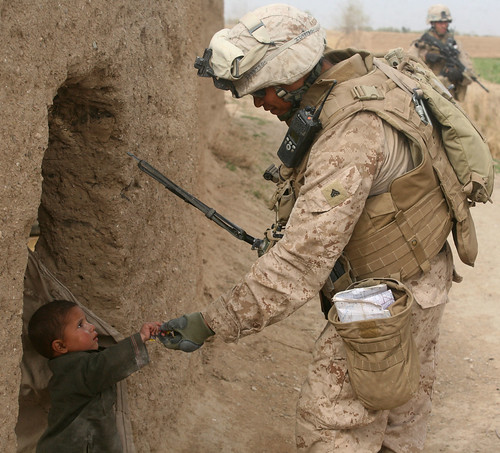 |
| Photo by Lance Cpl. Tommy Bellegarde |
Unfortunately, this is the wrong question. It rests on the assumption that the U.S. did something right in Nawa but something wrong in Marja, and the only thing to do is discover that error. At a deeper level, the assumption is that all events are conclusively influenced by U.S. policy - we can do it right or do it wrong, but ultimately we are the ones determining the outcome. I find this idea troubling. Accepting that the U.S. military is the decisive factor in the near-term future in Afghanistan means neglecting local relations and politics, national governance (or the lack thereof), and a host of other factors, not the least of which is the most fundamental of all military strategy - the enemy gets a vote.
Chandrasekaran almost hits on this point, but quickly loses the thread:
But the residents also emphasized that the Taliban fighters left of their own accord. "They chose to flee from here," said one shopkeeper. "They drove away as soon as the Marines arrived."In other words, perhaps the success in Nawa was not the result of superior American tactics, but rather of a Taliban miscalculation. Their failure in Nawa may have been part of the reason the Taliban refused to flee Marja; an attempt to avoid repeating the mistake.
So what does this mean for U.S. operations in Afghanistan? It's a reminder that actors and events that are not part of the plan influence the outcome, sometimes decisively. As the Bush Administration learned in the aftermath of the fall of Baghdad, unplanned events occur and must be dealt with, even if that means discarding the original blueprint. COIN doctrine cannot be implemented according to any book, and the notion that there is a "right" way to do COIN which guarantees success is a fallacy. Perhaps General Petraeus has taken a similar lesson from recent events. He has reportedly decided to scrap the invasion Kandahar, calling the current plan "not an appropriate model." Kudos to P4 for making the right call, and hopefully this is only the first of many.
 Labels:
Afghanistan,
COIN,
Dave Reidy,
General Petraeus,
governance,
insurgency,
Marjah,
Nawa,
Rajiv Chandrasekaran
|
Labels:
Afghanistan,
COIN,
Dave Reidy,
General Petraeus,
governance,
insurgency,
Marjah,
Nawa,
Rajiv Chandrasekaran
|
 1 comments
General David Petraeus took command of American and NATO troops in Afghanistan on Sunday.
Many are considering this change of command to be little more than a change in nameplates, as President Obama has made it clear that US and NATO policy in Afghanistan will not change with the removal of General McChrystal. As we at Demagogues and Dictators seek to provide multi-faceted analysis of issues, I thought the below image provided an excellent graphical evaluation of the situation (courtesy of Doctrine Man)
On a serious note, I do think that the transfer of command is significant, even with all parties involved professing fealty to the current strategy.
Why? Because personalities matter, even in war.
Anyone who has ever spent time in any office (or pretty much anywhere, for that matter) can tell you that individuals who don't get along find it difficult to work together. Even if the dysfunctional triangle of General McChrystal, Ambassador to Afghanistan Eikenberry, and AfPak Envoy Richard Holbrooke never led to any purposeful undermining, poor (or very bad) communication is disruptive on many levels. First, and foremost, it causes a breakdown in staff communication farther down the chain. Second, it makes it that much more difficult for the US military and the US civilian agencies to understand what the other requires, something that is already difficult in the most hospitable of conditions. Third, it forces the United States to show a divided front in Afghanistan, and to all of the myriad actors important in the conflict (Pakistan, India, Russia, NATO, etc.).
Effective communication won't fix anything overnight, but they do improve ISAF's chances. In the jargon of the social sciences (I know, I can't resist), effective communication between civilian and military actors doesn't provide the permissive conditions for a successful counterinsurgency campaign, but they almost certainly are a necessary condition.
I don't know if General Petraeus will be able to work effectively with Ambassadors Eikenberry and Holbrooke, but I know that General McChrystal couldn't. That alone is reason for some hope.
Kabul, Afghanistan
The bottom line of what has happened to General McChrystal is that he was betrayed by his aides, who were supposed to be the ones protecting him from this sort of thing. The reporter from Rolling Stone was supposed to have two weeks of access to the staff, but because of the Iceland volcano and the resultant ash cloud he ended up getting stuck with McChrystal's team for a month. During that time the staff essentially "went native" with the reporter and started speaking too freely. If you read the article, all the bad stuff is said by McChrystal's aides, who imply that they are expressing the boss' feelings.
The rumor mill here in country speculates that perhaps McChrystal wanted out and this was how he decided to do it. But that is quite ridiculous, since there is really no bigger disgrace for a military man than to be fired by the Commander-in-Chief. While I understand the political reasons for why Obama removed McChrystal, I think a major blow has been struck to the effort here in Afghanistan. As we speak, instead of concentrating on the fight at a time of year that is the most kinetic we have seen in the past 9 years, the entirety of command is either packing their shit in boxes (as its not just the boss who gets fired but his whole staff) or preparing several weeks worth of briefs for Petraeus when he gets here.
Stay in the Loop!


 Posts
All Comments
Posts
All Comments
Our Favorite Blogs


.jpg)