
On Thursday, Rear Admiral Nora Tyson took command of Carrier Strike Group Two aboard the USS George H. W. Bush. Tyson made history, becoming the first woman to command an aircraft carrier in the US Navy. When Tyson received her first commission in 1979, women for the first time became a Surface Warfare Officer and a carrier-certified Naval aviator. Women were not given permanent assignments on board combat ships until 1994.
Congratulations to Rear Adm. Tyson!

One of the major revelations to come out of the 92,000 previously classified documents recently released by wikileaks is that apparently the Taliban have on several occasions fired at U.S aircraft using surface to air missiles better known as MANPADS (Man Portable Air Defense Systems). The media has seized upon this story as yet another government blunder since after all wasn't it the U.S. government who originally supplied the Mujahideen with stinger missiles back in the 80's when they were fighting the Soviets? However, a closer examination of the specs on these stingers leads one to a far different and perhaps more dangerous conclusion; that Pakistan has begun to supply the Taliban with their own surface to air missiles to use against U.S. forces.
I had often heard that there were several hundred stingers unaccounted for after the withdrawal of Soviet forces from Afghanistan and when I was there this summer I asked the crews of helicopters I was flying on why it was that we no longer considered these weapons a threat. According to weapons experts, the batteries on stinger missiles are good for one shot each and they must be changed out if the delivery system is to be used more than once. Furthermore, the average shelf life of unused batteries is only 4-5 years. Meaning that any stinger missiles given to the Mujahideen in the 80's would no longer be effective today. While it is not beyond the realm of contemplation that a skilled technician could jerry rig some sort of alternative battery for these devices, such skill is likely out of the range of the vast majority of Taliban. These weapons are however still capable of exploding, only the delivery device is deactivated. As such a great deal of the remaining stingers left over from the 80's have probably since been turned into IEDs.
The fact remains however that the Taliban are getting fully functioning MANPADS from somewhere, which in all likelihood have been constructed in the last 4-5 years. The most likely candidate is Pakistan which is both the traditional patron of the Taliban and has for the last twenty years been a manufacturer of their very own surface to air missile known as the Anza. The Anza has an effective range of up to 5000 meters and could certainly have been behind the downing of several US helicopters in recent years. In recent years, Pakistan has advertised the Anza series for export,displaying it at the International Defense Exhibition (IDEX) 2007 event in the UAE.
Worst case scenario: The Pakistani ISI is directly providing the Taliban with surface to air missiles
Best Case: Pakistan is irresponsibly selling MANPADS on the open market and they are ending up in the hands of the Taliban through a middleman
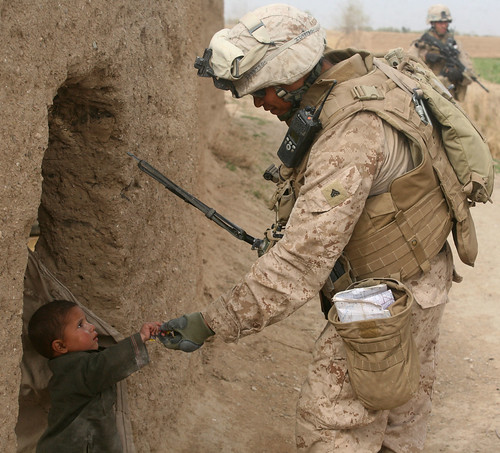
The always-superb Rajiv Chandrasekaran has a story in the Washington Post about progress in Afghanistan, comparing the lack of it in Marja (a "bleeding ulcer," as General McChrystal famously said) with the relative tranquility and prosperity of Nawa. Both hamlets are similar demographically and geographically, but while Marja continues to hemorrhage Nawa is creeping forward.
Both were stricken by the Taliban insurgency four years ago. And over the past year, both have been treated with America's new counterinsurgency formula: Each community has been flooded with U.S. Marines and Afghan security forces, at troop levels that meet or exceed what counterinsurgency theorists prescribe. Each has received a surge of cash and civilian experts in an effort to provide public services, rebuild infrastructure and dole out basic economic assistance. Each has been described as a priority by the central government in Kabul. So why did all this work in one but not the other?
 |
| Photo by Lance Cpl. Tommy Bellegarde |
Unfortunately, this is the wrong question. It rests on the assumption that the U.S. did something right in Nawa but something wrong in Marja, and the only thing to do is discover that error. At a deeper level, the assumption is that all events are conclusively influenced by U.S. policy - we can do it right or do it wrong, but ultimately we are the ones determining the outcome. I find this idea troubling. Accepting that the U.S. military is the decisive factor in the near-term future in Afghanistan means neglecting local relations and politics, national governance (or the lack thereof), and a host of other factors, not the least of which is the most fundamental of all military strategy - the enemy gets a vote.
Chandrasekaran almost hits on this point, but quickly loses the thread:
But the residents also emphasized that the Taliban fighters left of their own accord. "They chose to flee from here," said one shopkeeper. "They drove away as soon as the Marines arrived."In other words, perhaps the success in Nawa was not the result of superior American tactics, but rather of a Taliban miscalculation. Their failure in Nawa may have been part of the reason the Taliban refused to flee Marja; an attempt to avoid repeating the mistake.
So what does this mean for U.S. operations in Afghanistan? It's a reminder that actors and events that are not part of the plan influence the outcome, sometimes decisively. As the Bush Administration learned in the aftermath of the fall of Baghdad, unplanned events occur and must be dealt with, even if that means discarding the original blueprint. COIN doctrine cannot be implemented according to any book, and the notion that there is a "right" way to do COIN which guarantees success is a fallacy. Perhaps General Petraeus has taken a similar lesson from recent events. He has reportedly decided to scrap the invasion Kandahar, calling the current plan "not an appropriate model." Kudos to P4 for making the right call, and hopefully this is only the first of many.
 Labels:
Afghanistan,
COIN,
Dave Reidy,
General Petraeus,
governance,
insurgency,
Marjah,
Nawa,
Rajiv Chandrasekaran
|
Labels:
Afghanistan,
COIN,
Dave Reidy,
General Petraeus,
governance,
insurgency,
Marjah,
Nawa,
Rajiv Chandrasekaran
|
 1 comments
The July 11 attacks by the Somali Islamist group Al-Shabaab killed more than 70 people watching the finals of the World Cup in Kampala, Uganda's lakeside capital city. The tragic bombings, and the response, have brought up an interesting issue in the field of international security - why countries react in different ways to terrorist attacks.
On one end of the spectrum is Spain's reaction to the March 11, 2004 attacks by "homegrown" Al-Qaeda members on the Madrid subway (Ed. note - why do so many terrorist attacks happen on the 11th day of the month?). The attacks occurred shortly before the 2004 parliamentary elections, and led to Jose Luis Rodriguez Zapatero's party, known by its Spanish acronym PSOE, taking power from the Conservative Jose Maria Aznar. In the aftermath of the election, tinged by Aznar's contention that the bombings were caused by the Basque separatist group ETA, Zapatero's government withdrew Spanish troops from Iraq.
On the other end of the spectrum is the U.S. reaction to the September 11 attacks in 2001, with a death toll of over 3,000. Within a month, after the Taliban refused to turn over Osama Bin Laden and other Al-Qaeda members, U.S. and allied forces had entered the country. On October 7, 2001, airstrikes began in Kabul. U.S. troops are still in Afghanistan today, 105 months after the initial invasion. 9/11, far from deterring future action, led directly to the U.S. invasion of Afghanistan.
In reacting to the 7/11 attacks, Uganda's government has remained uncowed, despite being singled out for attack by Al-Shabaab because of the presence of Ugandan peacekeepers in Somalia. President Yoweri Museveni was defiant, stating that "we shall go for them wherever they are coming from. We will look for them and get them as we always do." Although this rhetoric is not likely to be backed by immediate military action, Museveni's words are no retreat. In fact, he has already hinted at changing the mandate of the African Union peacekeeping mission in Somalia to one of "peace enforcement." Such a shift in the rules of engagement would allow for a more proactive military effort against Al-Shabaab.
Leaving aside the (important) question of why Al-Shabaab would attack Uganda or what their broader agenda may be, why did Uganda react in this way, and why do countries react so differently when responding to terrorism?
While we've been distracted by the ever-changing world around us and lost interest in Iran after sanctions were passed by Congress, life has rolled on in Tehran. But it has not rolled smoothly. Yesterday marked a crucial turning point in domestic relations, as merchants in the capital ended a 12-day strike.
Now why is this important? No, it's not the result of U.S. sanctions and is certainly no reason to declare a victory. And no, these strikes really are not similar to the mass protests and strikes of 1979 that brought down the Shah - the government is in no immediate danger of collapsing. But this strike is crucially important as an indicator that economic conditions in Iran continue to deteriorate and that the general populace has thus far been unswayed by the "Blame America" rhetoric from the regime.
Under the mismanagement of President Ahmadinejad, the Iranian economy has cratered. He spun profits from record-high oil prices into vast subsidy programs to bulwark domestic support, but when oil prices dropped those programs became massive government expenditures with no revenue backing. Not only did he miss an opportunity to expand and diversify Iran's economy, Ahmadinejad's fiscal cluelessness has now burdened the state with more debt than it can handle. The solution: higher taxes, which led directly to the recent strike.
Again, the regime is not in imminent danger. But these strikes illustrate the cost of financial imprudence, and without an economic turnaround even blatant vote-stealing won't keep the current government afloat.

The 2010 mid-term election is developing into a referendum on the economy, with foreign policy playing little to no role. A recent Gallup poll asks Americans what they think is "the most important problem facing this country today" and the conflicts in Iraq and Afghanistan tie with 3%. No foreign policy issue garners more than 7% (immigration) and the aggregate of the all the foreign policy-related issues is 17%. Americans are most daunted by the economy; 53% mention either the economy or unemployment/jobs as the most important problem.
This is occurring in an atmosphere where the public sees the President as competent in foreign affairs, but increasingly inept at handling the national economy. In a recent TIME poll, Obama retains a 52% approval rate on foreign policy (41% disapprove) and a 47/44 approval/disapproval rate on Afghanistan, but has only a 44% approval rate on the economy (53% disapprove). The President has been seen as more competent on foreign policy than on the economy since March 2009.
Finally, a majority of Americans both approve of the President's timetable for withdrawal from Afghanistan and approve of his decision to both remove General McChrystal and appoint General Petraeus, the latter by incredible margins.
There are two important implications of this polling data. First, foreign policy will be a non-issue for most of the 2010 campaign. With voters' attention disproportionately fixed on the economy, campaigns will be about jobs, jobs, and jobs. Of course the occasional congressional race will hinge on a foreign policy issue. Districts with large military bases or ethnic populations with specific foreign policy interests feature intense foreign policy debates, but they are not the norm across the country. However, even when foreign policy and national security are emphasized, it will likely occur in the context of, you guessed it, jobs.
Second, congressional support for President Obama's foreign policy won't flag, even with a Republican takeover of (one or both houses of) Congress. On the major foreign policy issues facing the United States, namely Iraq and Afghanistan, President Obama is supported heavily by the Republican minority. In fact, in the recent debate over supplemental funding for the war in Afghanistan, the main opposition was from liberal Democrats.
Democrats running for Congress this fall will be in a race against the economy, hoping it improves enough by October to argue that things are getting better. If the unemployment rate starts creeping down over the end of the summer, and September and October see big job gains, then Democrats can feel (somewhat) secure in the fact that they will only lose a few seats. If however, unemployment stays around 9.5%, or increases, watch for Democrats to suffer major losses in November.
Of course, all of this analysis exists in a place that assumes the absence of an "October surprise" - an event that would shock the electorate in a way so as to call into question their core electoral assumptions. I've stated previously that I thought the August 31st U.S. military draw-down in Iraq would have a similar effect, causing the electorate to focus on Iraq and the Middle East. I still think that will happen, but not anywhere near the amount required to make the mid-terms anything but a referendum on the economy. Even at the height of the CNN-led frenzy over the Gulf Coast oil spill, only 18% of voters listed the spill as the most important issue facing the U.S.
Gallup's "Bottom Line" sums up the issue nicely:
Although the precise percentage of Americans mentioning economic concerns varies from month to month, these issues have dominated the public's consciousness for well over two years. This fact should serve as a sharp reminder to politicians and challengers involved in House and Senate races this fall; failure to address economic issues will be at the candidate's own peril.
Breaking News:
Three synchronized bombs exploded in Kampala today during the World Cup final, killing at least fifty (some reports range to over 60). While many will turn their eyes to the LRA and Kony, there is another, game-changing possibility.
D&D Snap Analysis:
Synchronized explosions in crowded soft targets are not typical for the LRA, they are more typical to traditional AQ actions. This possibility is further magnified by comments made tonight by Sheik Yousuf Sheik Issa (al Shabaab Commander) in Mogadishu to an AP reporter:
"Uganda is one of our enemies...whatever makes them cry makes us happy. May Allah's anger be upon those who are against us."If this is an Al Shabaab operation, it will mark their first outside of Somalia, and a clear shifting in both their capabilities and aims within the region. It may also signal that they are seeking some form of horizontal escalation of their conflict inside of Somalia.
More on this soon, as more details emerge.
Stay in the Loop!


 Posts
All Comments
Posts
All Comments
Our Favorite Blogs


.jpg)