
The 2010 mid-term election is developing into a referendum on the economy, with foreign policy playing little to no role. A recent Gallup poll asks Americans what they think is "the most important problem facing this country today" and the conflicts in Iraq and Afghanistan tie with 3%. No foreign policy issue garners more than 7% (immigration) and the aggregate of the all the foreign policy-related issues is 17%. Americans are most daunted by the economy; 53% mention either the economy or unemployment/jobs as the most important problem.
This is occurring in an atmosphere where the public sees the President as competent in foreign affairs, but increasingly inept at handling the national economy. In a recent TIME poll, Obama retains a 52% approval rate on foreign policy (41% disapprove) and a 47/44 approval/disapproval rate on Afghanistan, but has only a 44% approval rate on the economy (53% disapprove). The President has been seen as more competent on foreign policy than on the economy since March 2009.
Finally, a majority of Americans both approve of the President's timetable for withdrawal from Afghanistan and approve of his decision to both remove General McChrystal and appoint General Petraeus, the latter by incredible margins.
There are two important implications of this polling data. First, foreign policy will be a non-issue for most of the 2010 campaign. With voters' attention disproportionately fixed on the economy, campaigns will be about jobs, jobs, and jobs. Of course the occasional congressional race will hinge on a foreign policy issue. Districts with large military bases or ethnic populations with specific foreign policy interests feature intense foreign policy debates, but they are not the norm across the country. However, even when foreign policy and national security are emphasized, it will likely occur in the context of, you guessed it, jobs.
Second, congressional support for President Obama's foreign policy won't flag, even with a Republican takeover of (one or both houses of) Congress. On the major foreign policy issues facing the United States, namely Iraq and Afghanistan, President Obama is supported heavily by the Republican minority. In fact, in the recent debate over supplemental funding for the war in Afghanistan, the main opposition was from liberal Democrats.
Democrats running for Congress this fall will be in a race against the economy, hoping it improves enough by October to argue that things are getting better. If the unemployment rate starts creeping down over the end of the summer, and September and October see big job gains, then Democrats can feel (somewhat) secure in the fact that they will only lose a few seats. If however, unemployment stays around 9.5%, or increases, watch for Democrats to suffer major losses in November.
Of course, all of this analysis exists in a place that assumes the absence of an "October surprise" - an event that would shock the electorate in a way so as to call into question their core electoral assumptions. I've stated previously that I thought the August 31st U.S. military draw-down in Iraq would have a similar effect, causing the electorate to focus on Iraq and the Middle East. I still think that will happen, but not anywhere near the amount required to make the mid-terms anything but a referendum on the economy. Even at the height of the CNN-led frenzy over the Gulf Coast oil spill, only 18% of voters listed the spill as the most important issue facing the U.S.
Gallup's "Bottom Line" sums up the issue nicely:
Although the precise percentage of Americans mentioning economic concerns varies from month to month, these issues have dominated the public's consciousness for well over two years. This fact should serve as a sharp reminder to politicians and challengers involved in House and Senate races this fall; failure to address economic issues will be at the candidate's own peril.
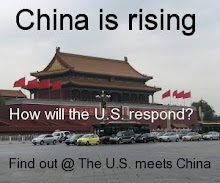
China's rise to great power status is moving along steadily, and US policymakers are acknowledging it publicly.
Secretary of Defense Robert Gates made the following comment at a June 16th Hearing of the Senate Appropriations Subcommitee on Defense (in response to a question about arms sales to Taiwan from Senator Dianne Feinstein):
And I was struck by an article in the local press in Singapore following that session. Somebody asked one of these Chinese generals or some Chinese general -- it may not have been one present -- "You guys have known about these sales for decades. Why all of a sudden are you raising such a stink about them?" And -- and this general's response was, "We had to accept it when we were weak. We are no longer weak."China has a long history of being pushed around by Western powers. It was "opened" by the British in the mid-19th Century (when the British acquired Hong Kong), and subsequently maintained as an open trading partner by force by various Western powers, including the US. As an underdeveloped country lacking economic and military power, China was (mostly) forced to accept the terms dictated to it by others.
Since China became the state we know today, it has espoused an ideology of "peaceful rising." In a nutshell, China knows it deserves a place among the great powers, but won't ruffle any feathers along the way.
Recently however, China has begun to assert itself. Its actions at the Copenhagen climate conference and its stance towards the sinking of the South Korean navy corvette Cheonan have alienated would-be partners, and have amounted to a policy that Daniel Drezner describes (diplomatically) as "Pissing Off as Many Countries As Possible."
Given this trend, how should the US address China today and in its future policies?
 Labels:
Beau Barnes,
China,
peaceful rising,
secretary gates,
Taiwan,
US foreign policy
|
Labels:
Beau Barnes,
China,
peaceful rising,
secretary gates,
Taiwan,
US foreign policy
|
 0
comments
0
comments
Stay in the Loop!


 Posts
All Comments
Posts
All Comments
Our Favorite Blogs


.jpg)