Well, let's just say I think it's unlikely. Tensions are high, and the North's provocative sinking of a South Korean warship requires a response. But what should that response be?
War is out of the question, at least from the American and South Korean side. North Korea could, if open hostilities commenced, inflict not-inconsiderable damage on the South, particularly Seoul, and possibly on Japan as well. A war would also have a destabilizing effect on the entire region, and could prompt a massive refugee crisis that all states, especially China, would like to avoid.
And what of sanctions? Well there really aren't many sanctions available to the international community that aren't already in place. Pyongyang has persevered under a myriad of sanctions over the years, with little discernible change in policy, and that option seems exhausted, save as a gesture of international condemnation.
So what can be done? Not much, it appears, unless South Korea, the US, China, Japan, and the UN Security Council agree to mount a large-scale invasion and regime-change operation. Needless to say, the odds of that happening are slightly smaller than winning the Powerball.
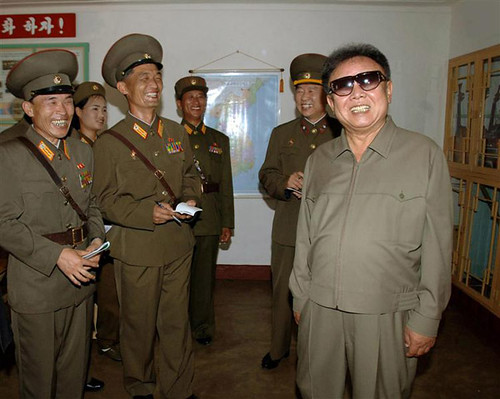
I believe the more pressing concern is about motivation - why did Kim Jong Il choose to attack a South Korean warship? I'm no expert on North Korea, but it seems to be an attempt to maintain his "irrational actor" status. If you accept that he is irrational, potent options - such as limited military strikes or more robust targeted sanctions - must be shelved under the notion that they may cause him to overreact, possibly with nuclear weapons. I think he is an eminently rational actor, interested solely in maintaining power and ensuring the succession of the family dynasty. If that is his goal, acting like a crazy person to keep the rest of the world off-balance is actually not so crazy. However, calling his bluff with surgical strikes is an extremely dangerous gamble with little upside.
The other key consideration is China. Beijing has been North Korea's most ardent supporter, and Chinese food aid nourishes many North Koreans. China fears the after-effects of a destabilizing regime change, with refugee flows across the border causing domestic upheaval. Kim Jong Il took a recent "secret" trip to China, and while the full contents of his conversations are not public it's safe to assume that the sinking of the Cheonan was on the agenda. As usual, China holds the balance of power and can influence the direction of future talks.
My prognosis: nothing. The Security Council may pass a few additional impotent sanctions, and South Korea will verbally lambaste the North, but no concrete action will be taken. Eventually the six-party talks will resume, with the status quo unchanged.
 Labels:

To all our readers,
I must start off by apologizing for my long absence from the blog. Being a grad student, I was sidetracked with a large number of other papers and neglected my duties to this site.
Since then I have traveled to Afghanistan where I will be living for the next five weeks. Tomorrow I start the Counterinsurgency Leadership Course after which I will be traveling outside of Kabul observing information operations. Over the course of this time I hope to be able to provide you with a series of observations from the field.
My first such observation has to do with the complete lack of emphasis that Western media has put on exactly how international the force here really is. Today alone I have interacted with a dozen Australians, 5-6 French troops, some Italian army and police, and even an Irishman, not to mention the countless numbers of Nepalese and Mongolians who provide perimeter security for the majority of ISAF bases here.
This failure or reporting I believe stems from the emphasis that the Bush administration but on the fact that the invasion of Iraq was an international effort comprising troops from over forty members of the coalition of the willing. The number of international troops involved in that conflict were indeed laughable when compared to the 150,000 U.S. troops present in Iraq. While in Afghanistan, U.S. troops do account for more than fifty present of the force here, the level of international commitment to the Afghan conflict is clear to anyone who spends more than 15 minutes on any base here.
Well, the Third Generation of the Global Jihad has landed smack dab back in the middle of the news. First off, apologies for my absence here on D&D -- finals landed pretty hard here at the Fletcher School, and I am only now coming out from under. The news about Faisal Shazhad should have been enough to jar me from my work, and back to blogging, but what can I say. Anyway, in the hopes of starting a discussion of Global Jihadi radicalization in the west (and some blatant self-promotion) here is the conclusion of my most recent paper on the subject. The paper (currently titled "Getting to Boom") seeks to analyze and synthesize the current theories and frameworks explaining self-starter radicalization.
I do hope to be adding more pertinent context vis-a-vis the Times Square "wanna-bomber", but for now, here is my valiant attempt of doing two things at once -- paper writing and blogging:
Conclusions and Today's Threat Environment:
Many scholars, social psychologists, and counter-terror analysts have sought to accurately describe the process of radicalization that transforms a Western citizen to shahid...
William Dalrymple is one of my favorite writers. City of Djinns, The Last Mughal, and White Mughals are among the finest sources available on the history of India, and From the Holy Mountain is an intellectual travelogue, blending the ancient and modern Middle East. But his recent op-ed in the New York Times, The Ghosts of Gandamak, is a disappointment. Dalrymple's sense of history and lively narrative ability are abundant, but his decision to abuse the tired trope about Afghanistan's invulnerability to conquest is a waste.

This story is sadly easy to believe. However, its relationship with the 1842 massacre is unclear. Dalrymple attempts to draw the lesson that military solutions alone are inadequate; if that's the status of the enlightened discourse about the Afghanistan campaign we are all in dire straits. That a political initiative is needed is apparently to all non-comatose observers, and although Dalrymple's advice to negotiate with the Taliban may be correct, it is in no way supported by his historical analogy.
I find it infuriating when a discussion of strategy in Afghanistan is hijacked by the fallacy that it is an inherently ungovernable zone. This position invokes the argument Seth Jones made when writing In the Graveyard of Empires: that would-be conquerors, from Alexander the Great through the British Empire, met their downfall in the mountains and valleys of Afghanistan at the hands of fiercely independent natives. The only lesson that can be learned from this teleological reading of history is to avoid Afghanistan at all costs, because forces sinister and free lurk to thwart the aspiring invader.
This notion, to be charitable, is rubbish. Afghanistan is difficult to govern because of its vast size and rugged terrain, but it is scarcely the only inhospitable ground on earth. It is no more or less difficult to control than any topographically similar area. Relying on this simplistic formulation to explain contemporary events dangerously obscures important factors and places undue emphasis on irrelevant areas.
There is value in Dalrymple, but it has nothing to do with the failings of the British or events of 1842. Instead, his tale should serve as another reminder of what we already know: no measure of success is possible in Afghanistan without good governance from Kabul; but all parties are falling drastically short in that metric. A failed 19th century British invasion holds no explanatory power nor relevant information about the continuing failure of President Hamid Karzai to provide basic services or tackle corruption, and that is the point which matters.
We seem to have sparked a debate here about the LRA, and I invite everyone to contribute. This is a complex issue fraught with implications for human rights, sovereignty, and regional politics, and I think it would behoove us all to carefully unpack and analyze each component.
To begin with, commenter "Caroline" raised some excellent points about the desirability of a military approach and other alternatives, and I would like to highlight her thoughts and respond to here.
Caroline:
Dave, Thanks for writing about this important topic on your blog. I generally agree with your arguments here but have to disagree on a few points.
First, you say "America has the power to catch Kony, but not the will." I agree with you that the US will never deploy troops to capture or kill Kony. No matter how many human rights organizations jump up and down decrying the abuses of the LRA, the US will never deploy troops to capture or kill Kony. I am less certain, however, that the US actually has the power to do so -- effectively. Granted, I am not an expert on the tactics and capabilities of US Special Forces, but if faulty US intelligence was one of the reasons why the attack on Kony in December 2008 failed so catastrophically, I am not confident that the US is the best candidate for capturing him. In order to carry this out, the US would have to spend a significant amount of time gathering intel on a region of northeastern Congo and southeastern CAR that I am almost certain they are not familiar with. I highly doubt the US would commit Special Forces to spend the required amount of time gathering this intel if they did decide to launch an operation. And if they don't gather the intel, the operation will no doubt fail. Again.
This leads me to my second point. I believe discussing the military option surrounding the LRA is not a constructive debate. Neither the US nor the EU will commit the time or troops needed to capture Kony, so any operation they launch would likely fail. Continuing the debate on the military option, in my opinion, is not the direction the debate should be going. I realize there are strong vested interests in Uganda that encourage this debate, but it is a dangerous one. One glance through the Human Rights Watch reports on the consequences of the December 2008 operation should lead readers to understand that pursuing this route is both foolish and highly irresponsible given the civilian costs.
What then is the solution? I don't have an easy one. I would advocate for a return to the negotiating table, an increase in MONUC deployments (with contingents ready to use force to defend civilians) to areas at risk from LRA attack, an increase in Ugandan and possibly Rwandan deployments to Obo in CAR, and strong US, EU, and AU pressure on Khartoum to stop its recently renewed support to the LRA. All of these efforts should be focused on the protection of the civilian population, not on killing Kony. Pursuing the military option is entirely irresponsible and disregards the reality of civilian life that is lost in its wake.
Thanks in advance for considering my comments.
First of all, thanks for reading. You make some insightful and important points, and I think you and I agree on most aspects here.
Your first point, about the necessity of good intel to catch Kony, is absolutely true. It's one of the many reasons I believe the U.S. won't become more heavily involved. As you point out, gathering intel requires personnel, time, and money, and I don't believe the Obama Administration is prepared to commit those resources for a sustained effort. The difference between the U.S. and the regional governments is in capacity. The U.S. could put together the required intel if so inclined, whereas the Ugandan, Congolese, Sudanese, and CAR governments simply don't have the ability to undertake such a large, complex operation.
Your second point is also quite astute - I agree that the military option holds little promise so long as the US and EU are not willing to commit. Not only is the military option unlikely to catch Kony, but it also comes with severe human rights consequences, as you point out. This unfortunately is not a new aspect to the campaign against the LRA; the Ugandan military was responsible for despicable human rights violations in northern Uganda when pursuing Kony.
I disagree, however, with your conclusions.
In case you're just tuning in, a few weeks ago Michael Wilkerson wrote a piece for FP entitled "Why Can't Anyone Stop the LRA." I quibbled with a few points, and wrote up my objections here on D&D. Michael got wind of my response and wrote a supremely cogent rebuttal on his own blog, at which time the sheer hell of finals derailed me from ever posting a response. Here, slightly belatedly, is my answer (could we call it a re-re-response?).
While it's tempting to allow this to degrade into a snarky blog-war, (because, let's face it, that's fun) I prefer more serious analysis, and in fact Michael and I agree on most points. And even where our opinions differ, I wouldn't say we disagree so much as we have slightly different interpretations.
We agree (and Michael, please correct me if I err here) that the regional governments, South Sudan, CAR, and DRC, are extremely weak. Michael notes that "regional governments are working together - at least on paper" and I agree, and it seems as though we concur in our analysis that this coordination is, practically speaking, essentially worthless.
We also share the belief that if the U.S. was seriously committed the LRA would soon be eliminated. He has a great line here about the level of American commitment:
But that’s akin to saying if Congress really wanted to balance the budget it would eliminate corn subsidies. There may be a lot of truth there but that doesn’t put it very far within the realm of political possibility.I agree wholeheartedly here; and Michael I would like to eventually discuss the merits of the increasing U.S. military presence in Africa. My point in raising the specter of greater U.S. involvement in the chase for Kony is to critique those very factors that make it an infeasible outcome - America has the power to catch Kony, but not the will, and this must be considered among the sad reasons the LRA is still at-large.
But we do have our disagreements. At the end of his rebuttal, Michael objects to my characterization of the Ugandan forces as "rag-tag" and points to the presence of former LRA fighters in their midst to substantiate his point. I respectfully disagree. Perhaps the term "rag-tag" is altogether too vague. I take the point that these are not bottom-of-the-barrel troops - certainly these Ugandan units are superior to their Congolese colleagues. And they appear to be better behaved than other branches of Ugandan military, which committed innumerable human rights violations in the campaign to chase the LRA from Uganda. The Gettleman article Michael cites even quotes a representative from Human Rights Watch praising their behavior, a welcome change from the past.
But talk about damning with faint praise - those are some weak comparisons. Militarily, perhaps the best way measure of the competence of the Ugandan troops is to look at their results, and they are not positive. Kony is still roaming free, and reportedly has popped up everywhere from the DRC to Darfur. And even with logistical aid from the U.S., as Michael touts, and intel contributions prior to Operation Lightning Thunder, they have been unable to corral Kony.
This is where Michael and I differ most sharply, though on a theoretical rather than practical level. I believe that part of the reason the LRA remains at large is a failure to accurately conceptualize and analyze them as an organization. The LRA lacks serious political goals (Kony occasionally pays lip service to the idea of ruling Uganda, but his actions belie that goal). Nor do they have the support of the populace, on ethnic or ideological lines, to conduct a classic Maoist Peoples War. But, on the other extreme, they don't seem to be engaged in criminal trafficking except to support their own existence. In short, who the hell are the LRA? If they aren't traditional insurgents or guerrillas, but they aren't criminals, who are they?
This is not simply an academic question. How can you effectively target a group if you don't understand their motives and goals? Overlooking the nature of the LRA is one of the reasons Operations Lightning Thunder was such a spectacular failure. The Ugandan military (and, presumably, their U.S. supporters) were stuck in the old RMA mindset about the superiority and universal applicability of air power. The massive bombing raids that characterized the operation would have been appropriate for the skies over Nazi Germany, but not for finding and eliminating a small group of fighters. New enemies call for new tactics, and that lesson has gone unheeded.
There is some promise of innovation in the Ugandan's use of former LRA members as trackers, but it is an incredibly risky move and I think it also speaks to the paucity of ability among Ugandan units. I have seen no coherent attempts to understand the existence of the LRA as anything but a band of cult killers and their brainwashed followers. Even if that is their raison d'etre, there needs to be some work done on utilizing that information to form a coherent strategy. Simply hunting Kony across such a vast area with little idea of where he will go next, or why, is an awfully tall task.
I don't pretend to know how to understand the LRA, and so I'll bounce that (possibly impossible) question back to Michael. But I do think it's important to become familiar with the enemy, otherwise any strategy risks being misguided.
In the final tally, Michael and I seem to see eye-to-eye on most aspects of the LRA. But, Michael, what do you make of the LRA, and can we use that information to better formulate a strategy for stopping them?
Apologies to all for my absentee blogging. I'd like to come up with a detailed and sophisticated explanation, but quite simply finals are kicking my ass and I have no free time to sleep, let along blog.
I have quite a list of topics to tackle, starting with my long-overdue response to Mike Wilkerson about the LRA and some thoughts on the latest RAND study. With any luck I'll be back in the flow next week.
Until there, here are is a bizarre, insane, and utterly fascinating Vanity Fair story about a born-again American Hells Angel, roaming Sudan and trying to kill Joseph Kony.
Stay in the Loop!


 Posts
All Comments
Our Favorite Blogs