I have been meaning to write a post recently concerning muttering that I have been hearing from individuals with experience in Iraq about the very real possibility that Iraq may be in store for another civil war. Yesterday's coordinated attacks by insurgents are a chilling sign that it is far too soon to be breathing sighs of relief over the state of Iraq. The bombings that occurred on Tuesday took place over the course of two hours in 13 different cities including Fallujah, Ramadi, Tikrit, Kirkuk, Basra, Karbala, Mosul and Kut. If these names sound familiar, they should as they have been the sites of some of the most heavy insurgent activity over the last seven years. These attacks represent three main points; 1. that the insurgency is still alive, 2. they still maintain an organizational capability that allows them to coordinate attacks all across Iraq, and 3. the insurgents are still in possession of a great deal of explosives.
While the Iraqi government and U.S. forces both estimate the Iraqi insurgency to number only in the hundreds, these malign actors are not the main focus of concern for people who have been observing Iraq closely these past few years. Politics and ethnic divides are far more likely to split Iraq than the actions of a few well armed fanatics.
The most likely fault line for civil war in Iraq is the oil rich city of Kirkuk. The majority shiite population of Iraq strongly favors having all the countries oil revenues come under the control of the central government, which is of course mostly controlled by Shiites. The Kurds residing in Northern Iraq have for years now claimed Kirkuk as the capital of their state within a state and they are vehemently opposed to the Iraqi government infringing upon their chief revenue stream. The Kurds have for years now been silently (or not so silently if you live there) ethnically cleansing Kirkuk of Sunni and Shiite Arabs alike. The Kurdish paramilitary force, the Peshmerga, while distinctly smaller than the Iraqi military would still be capable of making a stand against the Iraqi state should there be a show down over the sovereignty of Kirkuk and its mineral wealth. Should such a conflict lead to the Kurds declaring an independent state this would only serve to make matters worse as such a declaration would surely force Turkey to get involved militarily seeing as how they have been dealing with their own Kurdish uprising for decades.
Another likely source of trouble in Iraq's near future is the rumored return of the radical cleric Moqtada al-Sadr who for the past several years has been in self imposed exile in Iran where he has been studying to become an Ayatollah (I am told he is still very far away from deserving such a title). A recent article in Foreign Policy Magazine entitled the King of Iraq highlights the immense amount of power Sadr is still capable of wielding in Iraq. However, the article is poorly titled as Sadr is much more a king maker than he is a king. Iraqs deposed and yet still sitting Prime Minister Nouri al-Maliki owed his election to Sadr's support. He also likely owes his latest electoral defeat to the fact that Sadr turned on him after the Iraqi government started allowing the U.S. military to attack Sadr's Mahdi army.
We must now ask ourselves what happens if Sadr returns to Iraq intent on seeing his candidates placed in the positions of greatest power within the Iraqi government. Iraq's Sunni population is not likely going to take such a grab for power lying down. Memories of Mahdi Army death squads killing Sunni's in hospitals as a result of Sadr controlling the Ministry of the Interior are still fresh in the minds of most Sunnis. But if Sadr does not get his way it is a very real possibility that we will see a resurgence of the Mahdi army, which it is important to point out, was never disbanded or disarmed despite the fleeing of its leader to Iran.
Other theories for what may lay ahead in Iraq's future include: the resurgence of another strong man dictatorial government, increasing power plays by Iran, or god forbid another ethnic conflict between Sunnis and Shiites like the civil war we already saw play out from 2006-2007. I am not trying to spread the message of doom and gloom, as I will be the first to admit that the Iraqi security forces have come along way in the past 3-4 years. All I am saying is that we here in the America should hold off on printing another Mission Accomplished banner anytime soon.
We here at D&D are still enjoying our August recess, but fear not, we shall return soon. In the meantime, the NYT featured a story today from Dexter Filkins about how the ISI used the CIA and American resources to arrest Mullah Baradar for their own, self-serving ends.
“We picked up Baradar and the others because they were trying to make a deal without us,” said a Pakistani security official, who, like numerous people interviewed about the operation, spoke anonymously because of the delicacy of relations between Pakistan, Afghanistan and the United States. “We protect the Taliban. They are dependent on us. We are not going to allow them to make a deal with Karzai and the Indians.”Well that's discouraging. And who could have ever imagined that was the case?
A few days ago Secretary of Defense Robert Gates announced that he is would like to see the Defense Department cut $100 billion from the defense budget over the next five years. As someone who has studied the defense budget in depth over the past few years at both the Kennedy school and the Fletcher School I have written the following memo outlining ways in which the DoD can cut $150 billion from the defense budget by 2016.
Returning the defense budget to pre 9/11 levels will force us to prioritize future threats and explicitly define the strategic purpose of each branch of the armed forces. Budgetary constraints will finally shift us away from our current Cold War mix of combat capabilities towards a new 1-3-2-1 force planning construct. Under the new formula, the U.S. military will be responsible for defending the United States (1); maintaining forces capable of deterring aggression in NE Asia, the East Asian littoral, and Middle East (3); actively partner with allies to perform stability operations in two of these regions (2); and maintain a capability to win decisively in one war against a conventional or WMD armed adversary (1).
Analysis of the future threat environment has concluded that unconventional wars are the most likely conflicts facing the U.S for the foreseeable future. In order to properly mitigate this threat, the armed forces must elevate irregular warfare, counterinsurgency and stability operations to the status of “core missions.” While critics will argue that prioritizing unconventional threats will leave us vulnerable to attack by conventional actors, the lack of a near-peer competitor makes this a low-risk opportunity to remodel our force structure to battle more current and likely threats. Institutionalizing counterinsurgency and stability operations will allow the U.S. military to respond to a broader range of threats at a greatly reduced cost. The following suggestions are ways to reduce the defense budget to approximately $400 billion by FY 2016. Suggested cuts translate to $104.7 billion in annual savings and an additional $159.7 billion in long-term savings resulting from a reduction in F-35 procurement over the next ten years.
Reduce End Strength to Near FY 2000 Levels ($63.3B in annual savings)
By reducing the overall end strength of the land forces to FY 2000 levels, we can decrease annual defense spending by an estimated $61.3 billion. The majority of savings can be found by first rolling the Army back to ten divisions each consisting of three combat brigades, a total reduction of 67,620 soldiers. From the remaining force, we should eliminate one armored division and one light infantry division to form two stability and reconstruction divisions each consisting of 10,000 troops. These divisions will allow special operations forces to focus on direct action by taking over training of indigenous security forces and most other COIN/Stability operations. CBO estimates that this restructuring would save the Army $32 billion over the next 16 years ($2 billion annually) due to the smaller number of units that would require modernization and the reduced need for next generation weaponry. One area of growth for the Army should be the 20th CBRNE Support Command, which should be doubled in size to 12,000 soldiers in order to be able to assign an EOD team to every BCT and a CBRN unit to each division. If we are no longer engaged in large scale combat operations, the Marine Corps will also be forced to reduce its numbers from 202,000 back to 172,000. While the Army and Marine Corps will likely object to large scale reductions in their end strengths, our new force planning construct no longer calls for us to fight two simultaneous conventional campaigns and thus maintaining the current number of combat forces is no long necessary
Reduce the Number of Foreign Military Bases by 25% (Cost of $30B, yields $25.5B in annual savings)
Of the 737 U.S. military bases currently operating worldwide (not counting in Iraq and Afghanistan) 427 (58%) are located in Europe. While the majority of our future planning and acquisition programs are oriented around fighting and deterring threats emanating from the Middle East and Asia, the U.S. military’s antiquated basing structure is still largely focused around deterring a Soviet threat that no longer exists. I propose reducing our global footprint by ¼ through the closing of 145 of these bases: 112 in Germany, 6 in Belgium, 2 in Greece and 31 in Italy. While the cost of many of these bases is shared with allies, we can no longer justify a large presence to guard against a non-existent threat. This new round of BRAC will cost approximately $30 billion if begun in 2011, but should yield annual savings of $25.5 billion after 2016.
Reduce Procurement of the F-35 by 50% ($15.9B in annual Savings, $159.7B long-term)
Our lack of a peer competitor and our near term focus on unconventional warfare means that our emphasis on replacing our current generation air systems with next generation systems is unwarranted. Rather than purchasing thousands of new F-35’s, we should reduce procurement of this platform and instead replace air systems that have reached the end of their life cycles with the latest version of the same system. These newer systems are far more capable than the ones they replace and cost approximately half as much as next generation technology. A fifty percent reduction in the procurement of F-35’s will cut $159.7 billion from the total long-term procurement budget and translate to $15.9 billion in annual savings. While the Air Force and Navy will argue that such cuts will reduce the number of missions they are capable of flying, a portion of the F-35’s mission can be allocated to our new long-range bombers and UAVs.
Restructure the Navy to be a More Mobile and Cost Effective Force ($5.3B in savings over 5yrs)
Since the end of the Cold War, the Navy has failed to redefine its strategic purpose. Over the next decade, we must move the Navy away from its focus on maritime warfare towards its primary missions of supporting ground-based operations and protecting the sea lines of communication (SLOC). According to their long-term shipbuilding plan, the Navy plans to acquire 53 Littoral Combat Ships (LCS’s) to perform antiship, anti-submarine and countermine warfare at a cost of $33.1 billion. I believe that combining the Navy and Coast Guard’s Small Combatant Programs will provide the Navy with a capability that is superior for executing the peacetime elements of its maritime strategy, but also offers the speed and offensive capabilities necessary to guard against threats to the SLOC. Reducing the number of LCS’s purchased will allow the Navy to acquire the naval version of the Coast Guard’s National Security Cutter (NSC). The CBO estimates that swapping out 25 LCS’s for 20 NSC’s will save the Navy an estimated $5.3 billion.

On Thursday, Rear Admiral Nora Tyson took command of Carrier Strike Group Two aboard the USS George H. W. Bush. Tyson made history, becoming the first woman to command an aircraft carrier in the US Navy. When Tyson received her first commission in 1979, women for the first time became a Surface Warfare Officer and a carrier-certified Naval aviator. Women were not given permanent assignments on board combat ships until 1994.
Congratulations to Rear Adm. Tyson!

One of the major revelations to come out of the 92,000 previously classified documents recently released by wikileaks is that apparently the Taliban have on several occasions fired at U.S aircraft using surface to air missiles better known as MANPADS (Man Portable Air Defense Systems). The media has seized upon this story as yet another government blunder since after all wasn't it the U.S. government who originally supplied the Mujahideen with stinger missiles back in the 80's when they were fighting the Soviets? However, a closer examination of the specs on these stingers leads one to a far different and perhaps more dangerous conclusion; that Pakistan has begun to supply the Taliban with their own surface to air missiles to use against U.S. forces.
I had often heard that there were several hundred stingers unaccounted for after the withdrawal of Soviet forces from Afghanistan and when I was there this summer I asked the crews of helicopters I was flying on why it was that we no longer considered these weapons a threat. According to weapons experts, the batteries on stinger missiles are good for one shot each and they must be changed out if the delivery system is to be used more than once. Furthermore, the average shelf life of unused batteries is only 4-5 years. Meaning that any stinger missiles given to the Mujahideen in the 80's would no longer be effective today. While it is not beyond the realm of contemplation that a skilled technician could jerry rig some sort of alternative battery for these devices, such skill is likely out of the range of the vast majority of Taliban. These weapons are however still capable of exploding, only the delivery device is deactivated. As such a great deal of the remaining stingers left over from the 80's have probably since been turned into IEDs.
The fact remains however that the Taliban are getting fully functioning MANPADS from somewhere, which in all likelihood have been constructed in the last 4-5 years. The most likely candidate is Pakistan which is both the traditional patron of the Taliban and has for the last twenty years been a manufacturer of their very own surface to air missile known as the Anza. The Anza has an effective range of up to 5000 meters and could certainly have been behind the downing of several US helicopters in recent years. In recent years, Pakistan has advertised the Anza series for export,displaying it at the International Defense Exhibition (IDEX) 2007 event in the UAE.
Worst case scenario: The Pakistani ISI is directly providing the Taliban with surface to air missiles
Best Case: Pakistan is irresponsibly selling MANPADS on the open market and they are ending up in the hands of the Taliban through a middleman
The always-superb Rajiv Chandrasekaran has a story in the Washington Post about progress in Afghanistan, comparing the lack of it in Marja (a "bleeding ulcer," as General McChrystal famously said) with the relative tranquility and prosperity of Nawa. Both hamlets are similar demographically and geographically, but while Marja continues to hemorrhage Nawa is creeping forward.
Both were stricken by the Taliban insurgency four years ago. And over the past year, both have been treated with America's new counterinsurgency formula: Each community has been flooded with U.S. Marines and Afghan security forces, at troop levels that meet or exceed what counterinsurgency theorists prescribe. Each has received a surge of cash and civilian experts in an effort to provide public services, rebuild infrastructure and dole out basic economic assistance. Each has been described as a priority by the central government in Kabul. So why did all this work in one but not the other?
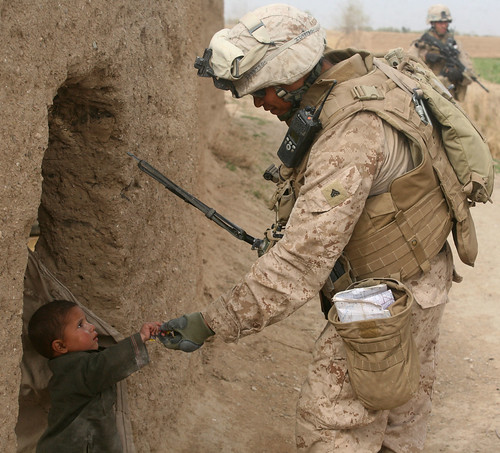 |
| Photo by Lance Cpl. Tommy Bellegarde |
Unfortunately, this is the wrong question. It rests on the assumption that the U.S. did something right in Nawa but something wrong in Marja, and the only thing to do is discover that error. At a deeper level, the assumption is that all events are conclusively influenced by U.S. policy - we can do it right or do it wrong, but ultimately we are the ones determining the outcome. I find this idea troubling. Accepting that the U.S. military is the decisive factor in the near-term future in Afghanistan means neglecting local relations and politics, national governance (or the lack thereof), and a host of other factors, not the least of which is the most fundamental of all military strategy - the enemy gets a vote.
Chandrasekaran almost hits on this point, but quickly loses the thread:
But the residents also emphasized that the Taliban fighters left of their own accord. "They chose to flee from here," said one shopkeeper. "They drove away as soon as the Marines arrived."In other words, perhaps the success in Nawa was not the result of superior American tactics, but rather of a Taliban miscalculation. Their failure in Nawa may have been part of the reason the Taliban refused to flee Marja; an attempt to avoid repeating the mistake.
So what does this mean for U.S. operations in Afghanistan? It's a reminder that actors and events that are not part of the plan influence the outcome, sometimes decisively. As the Bush Administration learned in the aftermath of the fall of Baghdad, unplanned events occur and must be dealt with, even if that means discarding the original blueprint. COIN doctrine cannot be implemented according to any book, and the notion that there is a "right" way to do COIN which guarantees success is a fallacy. Perhaps General Petraeus has taken a similar lesson from recent events. He has reportedly decided to scrap the invasion Kandahar, calling the current plan "not an appropriate model." Kudos to P4 for making the right call, and hopefully this is only the first of many.
 Labels:
Afghanistan,
COIN,
Dave Reidy,
General Petraeus,
governance,
insurgency,
Marjah,
Nawa,
Rajiv Chandrasekaran
|
Labels:
Afghanistan,
COIN,
Dave Reidy,
General Petraeus,
governance,
insurgency,
Marjah,
Nawa,
Rajiv Chandrasekaran
|
 1 comments
The July 11 attacks by the Somali Islamist group Al-Shabaab killed more than 70 people watching the finals of the World Cup in Kampala, Uganda's lakeside capital city. The tragic bombings, and the response, have brought up an interesting issue in the field of international security - why countries react in different ways to terrorist attacks.
On one end of the spectrum is Spain's reaction to the March 11, 2004 attacks by "homegrown" Al-Qaeda members on the Madrid subway (Ed. note - why do so many terrorist attacks happen on the 11th day of the month?). The attacks occurred shortly before the 2004 parliamentary elections, and led to Jose Luis Rodriguez Zapatero's party, known by its Spanish acronym PSOE, taking power from the Conservative Jose Maria Aznar. In the aftermath of the election, tinged by Aznar's contention that the bombings were caused by the Basque separatist group ETA, Zapatero's government withdrew Spanish troops from Iraq.
On the other end of the spectrum is the U.S. reaction to the September 11 attacks in 2001, with a death toll of over 3,000. Within a month, after the Taliban refused to turn over Osama Bin Laden and other Al-Qaeda members, U.S. and allied forces had entered the country. On October 7, 2001, airstrikes began in Kabul. U.S. troops are still in Afghanistan today, 105 months after the initial invasion. 9/11, far from deterring future action, led directly to the U.S. invasion of Afghanistan.
In reacting to the 7/11 attacks, Uganda's government has remained uncowed, despite being singled out for attack by Al-Shabaab because of the presence of Ugandan peacekeepers in Somalia. President Yoweri Museveni was defiant, stating that "we shall go for them wherever they are coming from. We will look for them and get them as we always do." Although this rhetoric is not likely to be backed by immediate military action, Museveni's words are no retreat. In fact, he has already hinted at changing the mandate of the African Union peacekeeping mission in Somalia to one of "peace enforcement." Such a shift in the rules of engagement would allow for a more proactive military effort against Al-Shabaab.
Leaving aside the (important) question of why Al-Shabaab would attack Uganda or what their broader agenda may be, why did Uganda react in this way, and why do countries react so differently when responding to terrorism?
Stay in the Loop!


 Posts
All Comments
Posts
All Comments
Our Favorite Blogs


.jpg)