
I would like to start out by making a disclaimer as this post is sure to generate some criticism. I am in no way anti-immigration, nor do I support government action restricting the rights of immigrants (legal or not) such as the law recently enacted in Arizona allowing police to demand proof of visa/citizenship from anyone they suspect of being in the United States illegally. My own father in fact is an immigrant to America. Demagogues and Dictators is at its core a security blog and the following is meant to bring your attention to a certain new technology that could have uses far beyond what the military is currently thinking.
For the past few years, the U.S. military has been developing what it is calling an "Active Denial System," or as Wired Magazine has dubbed it a "Pain Ray" (Aka the "Goodbye Weapon or the Vehicle Mounted Active Denial System (V-MAD)). When I first head of this device back in 2007, the military was testing to see if it could be used to non-lethally disperse crowds in Iraq. Essentially what this technology does is to concentrate microwaves across a limited distance. All organic tissue within a close proximity to the rays beam will experience an extremely hot sensation similar to opening a hot oven. From videos of the testing I have seen, the ray is very effective at getting people to instinctively move away from an area. The military claims that the weapon is entirely non-lethal and causes no permanent damage, although in one case a test subject had to be rushed to a hospital and treated for burns. As reported by Wired, this system has also recently been deployed for testing in Afghanistan
Now how does this relate to border security? Imagine a string of these microwave devices planted across the southern border of the United States all rotating in a random order such that only a minority of the border is hit with the ray at anyone time but ensuring that over a certain period of time the entire border is covered. This would negate the selective use of certain easy border crossing points as anyone crossing at any point along the border would risk being hit with the ray.
Human rights groups would obviously go crazy if the U.S. government were to even float the idea of such a system and I for one am not advocating it use either. However, I can imagine instances when such a system might have to be at least considered in emergency situations. Say for instance if terrorists were caught trying to smuggle nuclear material over the border. There would be in instant public outcry to seal the borders once and for all. You can't put up a huge fence overnight but you could deploy these Active Denial Systems in a matter of hours if you had a deployment plan already worked out. Furthermore, if the Mexican government were to fail, which according to the Defense Department is on par with the likelihood of the Pakistani government failing, the U.S government would need some way to temporarily stop a mass exodus of millions of people from Northern Mexico. In my opinion using this system would result in far fewer casualties than deploying the National Guard and the Minutemen down to the border armed with M-16's.
I know this is not a popular thought but we here at D&D believe that it is never wrong to think and we welcome any and all debate on this topic.
 Labels:
active denial system,
border security,
Jeremy White,
Pain Ray,
U.S. military,
V-MAD
|
Labels:
active denial system,
border security,
Jeremy White,
Pain Ray,
U.S. military,
V-MAD
|
 7
comments
7
comments

On Monday, the New York Times reported on a Defense Department memo claiming that under Afghanistan's hard terrain lays nearly a $1 trillion in mineral deposits. These minerals include large veins of iron, copper, cobalt, gold and lithium a vital component of computer batteries. But the reality of this story is that it is more of a propaganda campaign or "information operation" than it is real news. Yes it is true that these minerals do exist in Afghanistan but it is by no means news. The U.S. Geological survey made the discovery back in 2007. However, the U.S. government is pushing the story now because the coalition here has been rocked by some particularly bad press here the past week (Ironically from the New York Times. This causes me to wonder if the Times is attempting to buy its way back into the good graces of the Embassy in Kabul.) The most damaging of this press was comments attributed to President Karzai about the West not being able to win in Afghanistan. This story is similar to ones that preceded the Iraq War when the Bush administration claimed that Iraq's oil wealth would pay for all the costs of reconstruction.
The reason why news of these vasts deposits is no need to celebrate is simple. The minerals are worthless unless you can actually get private companies to come in here and mine them. And with the security situation what it is that is not likely to happen any time soon. Afghanistan for instance would be a great country to run oil pipeline through, stretching from Kazakhstan and Uzbekistan through Afghanistan to Pakistan and then on to China as well. However, despite a great deal of effort on the part of a U.S. company called Unocal they were never able to negotiate enough treaties with all the tribes and Taliban to agree not to blow up the lines or siphon oil from them. The one country with a mining contract in Afghanistan right now is China which now owns the largest copper mine here. They don't care about their people dying so it works out well for them.
The Taliban can't really mine anything so we don't really have to worry about them getting this revenue as they simply arent organized enough not to mention the lliterate enough. Furthermore, from this map you can tell that the majority of the deposits are located in Northern, Western and Central Afghanistan, all areas where the Taliban is not strong. The Taliban makes the majority of their money through taxes, which they are pretty good at collecting. They front farmers the money to buy opium poppy seed. They then take a percentage of the farmers cut when he sells his product to the local drug lord. They then also tax the drug lord for the right to move his product through areas they control. It is very mafia like here both in the government and the black market.
The other really bad thing about all these mineral deposits being discovered is that its really just one more thing for the government here to exploit for bribes. The Chinese got their copper mine for a song simply by paying a few million to the right ministers. The mine itself is worth billions.
I wasn't able to attend in person, but I did manage to watch a bit of the proceedings from today's conference at CNAS. They had a great cast of presenters, headlined by Michèle Flournoy, Under Secretary of Defense for Policy (and rumored successor to Bob Gates as SecDef) giving the keynote.

The basic premise, that the U.S. military was ill-prepared for the wars they are currently fighting, is sound. As is the underlying assumption, that these wars (call them small wars, hybrid, 5th generation, whatever) will be the most prevalent forms of kinetic conflict in the future. What concerns me is that fighting these wars is only possible because of American hegemony in traditional warfare. In other words, the U.S. ends up fighting small/hybrid wars/insurgencies because their dominance in all other aspects of warfare means that nobody is willing to even mount a challenge. But, if a majority of resources are shifted away from conventional operations, that could potentially leave the U.S. military open to a challenge from a near-peer rival (the most obvious candidate being China).
I'm not the first person to suggest this danger; in fact I think this places me firmly with the majority of military analysts. Nor am I pressing the panic button: I don't think this scenario is likely, and I think Gates/Flournoy are smart to seek an increase in the U.S. irregular/hybrid capabilities. But it's important to be cognizant that the pendulum can swing too far the other way and avoid becoming enamored with the latest and greatest in technology and strategy.
I wasn't planning to comment on the recent events involving Israel and the flotilla of humanitarian aid. The event has received saturation media coverage and, as an expert neither on the Middle East nor international law, I didn't feel I had anything new or valuable to contribute. However, readers have requested we address the topic, so I have no choice but to bow to their wishes (the customer is always right!) and add my two cents.
First of all, the fact that this ended with multiple deaths is tragic and was utterly avoidable. I'm not adequately equipped to wade into debate over the legality of Israel's actions, so I'll hold my tongue - but do check out the excellent discussion taking place over at Opinio Juris.
I do, however, feel sufficiently qualified to share the sentiments put forward by Stephen Walt and Dan Drezner - what the f*** were the Israelis thinking? They had to understand that this overreaction would have overwhelmingly negative consequences for them, and that having commandos forcibly board would inevitably lead to bloodshed. As the ever-astute Jon Stewart put it, perhaps those on board the ship thought the Israelis were greeting them with "commando-shaped pinatas." (Clip starts at 3:45)
| The Daily Show With Jon Stewart | Mon - Thurs 11p / 10c | |||
| Clusterf#&k to the War House - Korean Peninsula & Middle East | ||||
| ||||
Furthermore, I am disappointed in the response from the Obama Administration, which refused to condemn the incident and watered down the UN Security Council statement. The Administration could potentially use this tragedy to bring about meaningful change in Israel, by privately pressuring Netanyahu to make serious concessions while publicly protecting the Israeli government to offer political breathing space. That would be a delicate balancing act, and unfortunately I have yet to see any evidence to support that theory.
In addition to not being qualified to debate the legality of the incident, I also think that discussion is a bit of a sideshow. This was not an isolated incident; it is symptomatic of and caused by the long-standing Israeli-Palestinian deadlock. Immersing ourselves in the minutiae of international law may be missing the forest for a single tree, because the relevant issue isn't this incident, it's the situation as a whole. There can be no resolution to this tragedy nor a way to prevent future iterations without a comprehensive peace process, involving and satisfying all relevant parties.
Perhaps the fallout from this shoot-out will be the catalyst for breaking the decades of regional stalemate. But the overall situation is static: the Netanyahu government remains intransigent, Hamas refuses to recognizes Israel's right to exist, regional governments use the issue as a soapbox to enhance their "pro-Muslim" and "anti-West" credentials among their own radicals, and pro-Israel groups in America retain their influence. I'm not holding my breath for change.
Apparently the nothing I discussed is actually substantial enough to draw attention from militants, who attacked the jirga proceedings yesterday. In a perverse way, this is a positive sign for Karzai. Empty talks pose no threat to the Taliban, and therefore are unlikely to prompt a response. But a concerted attack indicates that they view the jirga as a threat. In a strange way, this attack serves to increase the legitimacy and potential of Karzai's peace talks.
I remain skeptical that the Afghan government will actually implement any governance improvements, but having a peace jirga attacked by militants is a twisted victory in the public information war.
The BBC has a question: can a jirga without rebel leaders bring Afghanistan peace?
The answer, obviously, is a resounding no. Duh.
But if the jirga is a kind of peace conference, it is rather one sided. The insurgents' leaders are not there. Hizb-e-Islami, a small militant group which has sometimes fought with the Taliban, said the jirga was of "no importance". "The participants of the jirga are state favourites," said a statement released by the group. "They have no power of decision. It is only a consultative jirga - without any participation of the Mujahideen."So what's going on with Karzai? Clearly the U.S. is backing this initiative, but only tepidly. The Embassy released a statement of support, but the process hasn't been emphasized by any of the leading American policymakers, most notably McChrystal, Holbrooke, and Clinton. NATO is in favor as well, but let's be honest: this jirga is nothing but empty talk. Karzai and Co. can continue talking the talk of governance and reconciliation, but without clear results, real progress, changes will not be forthcoming. And if we've learned one thing about Karzai over the past (almost!) decade, it's that he is willing to talk nice, but not follow through.
Well, let's just say I think it's unlikely. Tensions are high, and the North's provocative sinking of a South Korean warship requires a response. But what should that response be?
War is out of the question, at least from the American and South Korean side. North Korea could, if open hostilities commenced, inflict not-inconsiderable damage on the South, particularly Seoul, and possibly on Japan as well. A war would also have a destabilizing effect on the entire region, and could prompt a massive refugee crisis that all states, especially China, would like to avoid.
And what of sanctions? Well there really aren't many sanctions available to the international community that aren't already in place. Pyongyang has persevered under a myriad of sanctions over the years, with little discernible change in policy, and that option seems exhausted, save as a gesture of international condemnation.
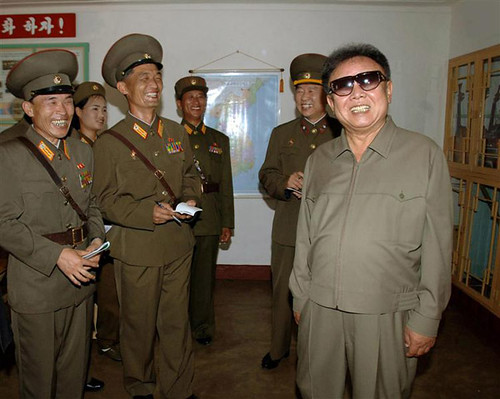
So what can be done? Not much, it appears, unless South Korea, the US, China, Japan, and the UN Security Council agree to mount a large-scale invasion and regime-change operation. Needless to say, the odds of that happening are slightly smaller than winning the Powerball.
I believe the more pressing concern is about motivation - why did Kim Jong Il choose to attack a South Korean warship? I'm no expert on North Korea, but it seems to be an attempt to maintain his "irrational actor" status. If you accept that he is irrational, potent options - such as limited military strikes or more robust targeted sanctions - must be shelved under the notion that they may cause him to overreact, possibly with nuclear weapons. I think he is an eminently rational actor, interested solely in maintaining power and ensuring the succession of the family dynasty. If that is his goal, acting like a crazy person to keep the rest of the world off-balance is actually not so crazy. However, calling his bluff with surgical strikes is an extremely dangerous gamble with little upside.
The other key consideration is China. Beijing has been North Korea's most ardent supporter, and Chinese food aid nourishes many North Koreans. China fears the after-effects of a destabilizing regime change, with refugee flows across the border causing domestic upheaval. Kim Jong Il took a recent "secret" trip to China, and while the full contents of his conversations are not public it's safe to assume that the sinking of the Cheonan was on the agenda. As usual, China holds the balance of power and can influence the direction of future talks.
My prognosis: nothing. The Security Council may pass a few additional impotent sanctions, and South Korea will verbally lambaste the North, but no concrete action will be taken. Eventually the six-party talks will resume, with the status quo unchanged.
Stay in the Loop!


 Posts
All Comments
Posts
All Comments
Our Favorite Blogs


.jpg)