The drumbeat of support for harsh sanctions against Iran continues, this time in a featured article from
Sanctions helped South Africa's pro-democracy movement. They can do the same in Iran.Really? They did? Because I seem to recall that the sanctions against South Africa were economically pathetic and insignificant. They had value as a message from the international community, but the meat of the sanctions did little. In fact, the ban on arms trade with South Africa, one of the core components of the sanctions regime (along with oil), had the perverse effect of transforming South Africa into one of the largest and most sophisticated arms manufacturers in the world (see Crawford and Klotz for details).
And oil, the second primary focus of the sanctions regime, continued to flow freely. Smuggling was rampant, and many states chose to defy the will of the international community to exploit a lucrative market. Ironically, Iran was the main player to do so (see Klinghoffer for more). In short, the international embargoes on goods had little effect on the apartheid regime, and certainly did not "marginalize and undermine the government" as
Mohsen Makhmalbaf, a filmmaker, to substantiate this claim. Unfortunately, all other supporting claims are from "a growing number of key opinion-makers and activists in the green movement," "other Iranian dissidents and activists," and "Iranian experts and analysts" - an impressive list of anonymous sources. I understand that personal security is a factor (nobody wants a knock on the door from the basij), but constructing an entire argument on nameless sources is poor analysis, especially when you factor in their dismissal of Mir Hossein Mousavi and other leaders speaking out against sanctions for "for what appear to be tactical reasons." So the opinion of Mousavi, who was the face of the Green Movement and actually stood for office, can be summarily dismissed, but the thoughts of anonymous "dissidents and activists" are grounds for robust sanctions.
Puzzlingly, the authors paint China and Russia as complicit in Tehran's pillaging of natural resources, yet do not recognize that sanctions are meaningless without full international cooperation. The U.S. could pass harsh unilateral sanctions on Iran, and would most likely be supported by many European allies. However, if Russia and, even more, China, could undermine any sanctions simply by continuing to trade. The growing energy appetite of China and Russian refinement capabilities could comfortably offset the loss of trade from the U.S. and Europe. In other words, the Obama Administration is constrained in what it can do, something the authors fail to recognize.
Harsh sanctions are not the answer in Iran. The risk of playing into the hands of Tehran's hardliners by acting as "the Great Satan" is high, and the potential payoff is low, especially without full international support. More troubling is the idea that the authors speak for "Iranians who yearn for democracy," yet fail to produce a shred of proof that the disparate members of the loosely-affiliated Green Movement would welcome international sanctions. Dubowitz and Weinthal, and Slate, should know better.
Well, let's just say I think it's unlikely. Tensions are high, and the North's provocative sinking of a South Korean warship requires a response. But what should that response be?
War is out of the question, at least from the American and South Korean side. North Korea could, if open hostilities commenced, inflict not-inconsiderable damage on the South, particularly Seoul, and possibly on Japan as well. A war would also have a destabilizing effect on the entire region, and could prompt a massive refugee crisis that all states, especially China, would like to avoid.
And what of sanctions? Well there really aren't many sanctions available to the international community that aren't already in place. Pyongyang has persevered under a myriad of sanctions over the years, with little discernible change in policy, and that option seems exhausted, save as a gesture of international condemnation.
So what can be done? Not much, it appears, unless South Korea, the US, China, Japan, and the UN Security Council agree to mount a large-scale invasion and regime-change operation. Needless to say, the odds of that happening are slightly smaller than winning the Powerball.
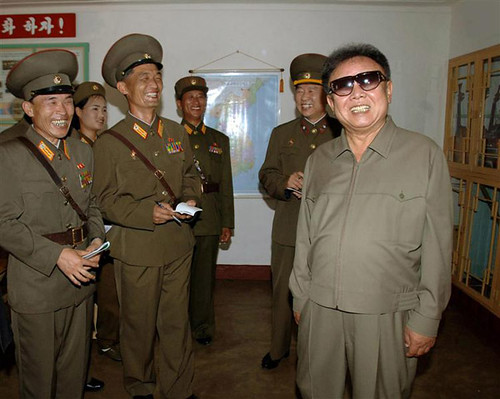
I believe the more pressing concern is about motivation - why did Kim Jong Il choose to attack a South Korean warship? I'm no expert on North Korea, but it seems to be an attempt to maintain his "irrational actor" status. If you accept that he is irrational, potent options - such as limited military strikes or more robust targeted sanctions - must be shelved under the notion that they may cause him to overreact, possibly with nuclear weapons. I think he is an eminently rational actor, interested solely in maintaining power and ensuring the succession of the family dynasty. If that is his goal, acting like a crazy person to keep the rest of the world off-balance is actually not so crazy. However, calling his bluff with surgical strikes is an extremely dangerous gamble with little upside.
The other key consideration is China. Beijing has been North Korea's most ardent supporter, and Chinese food aid nourishes many North Koreans. China fears the after-effects of a destabilizing regime change, with refugee flows across the border causing domestic upheaval. Kim Jong Il took a recent "secret" trip to China, and while the full contents of his conversations are not public it's safe to assume that the sinking of the Cheonan was on the agenda. As usual, China holds the balance of power and can influence the direction of future talks.
My prognosis: nothing. The Security Council may pass a few additional impotent sanctions, and South Korea will verbally lambaste the North, but no concrete action will be taken. Eventually the six-party talks will resume, with the status quo unchanged.
UPDATE at 2:00 PM EST
Iran has informed the IAEA that they will begin enriching uranium to 20% starting tomorrow.
UPDATE at 1:24 PM EST
Iran's supreme leader has threatened violence if planned opposition marches lead by Mir Houssein Musavi are carried out this week. Iranians will "punch [them] in the mouth to shock them" Ayatollah Khamenei promised -- though he demurred over who "them" is -- the protesters, their leadership, or the "western puppet-masters" he claims are instigating their "counter-revolutionary" behavior.
News on Iran's next move continues below.
From Reuters India:
TEHRAN (Reuters) - Iran will soon unveil a domestically-made air defence system with at least the same capability as Russia's S-300 anti-aircraft hardware, an Iranian air force commander was quoted as saying on Monday.For months, Iran has been attempting to...
 Labels:
air defense,
Iran,
IRNA,
Israel,
Jeff Schneider,
nuclear weapons,
Reuters,
s-300,
sanctions,
Vali Nasr
|
Labels:
air defense,
Iran,
IRNA,
Israel,
Jeff Schneider,
nuclear weapons,
Reuters,
s-300,
sanctions,
Vali Nasr
|
 0
comments
0
comments
My colleague Jeremy has a great post about the range of options available to Washington in dealing with the nuclear problem in Tehran. I agree with him that a military strike is an undesirable option. It is unlikely to succeed, and could be counter-productive by persuading the Iranians that it is in their vital national interest to go nuclear. I also agree with him that the Iranian economy is terribly vulnerable, especially to gasoline sanctions. The Obama Administration seems to share his enthusiasm for sanctions. Secretary Clinton recently came out in support of "targeted sanctions," which would attempt to punish the decision-makers in Iran, such as the Revolutionary Guard, but not harm the average Iranian. However, this approach is not without risks.
Firstly, an effective sanctions regime requires cooperation from the entire international community. If sanctions are to target gasoline, then oil-producing and refining nations are the key participants - without their support, any sanctions effort would fail. Saudi Arabia would most likely help any effort to stymie their Iranian nemesis, but other oil-producing states, such as Venezuela, may not be so forthcoming. The major question marks, as always, are Russia and China. If they can be persuaded to accede, sanctions stand a chance of squeezing Tehran. But if they, or large MNC's based in their territories, don't buy in, sanctions will be ineffective.
Secondly, economic sanctions against Iran are a risky gambit with the potential for severe blowback. The Iranian regime is internally isolated and faces a strong and growing opposition. Most reports speculate that the faltering economy is a key issue for the opposition movement and a significant source of dissatisfaction. The majority of the populace faults the government, not the international community, for their economic difficulties. This is notable because the trump card that the Iranian regime has often played in the past is to blame everything on "The Great Satan." By shifting responsibility for any and all woes that everyday Iranians face to the United States, the government has been able to shore up their domestic credentials and remain in power.
That tactic is currently failing. The Iranian government has been unable to convince the populace that America is behind their problems, and as a result the opposition movement continues to gather strength. Economic sanctions could reverse this trend, and enable the regime to shift blame onto the international community. While "targeted" sanctions solve this problem in theory, in practice it is difficult if not impossible to limit the pernicious effects of sanctions to a select few. Furthermore, the key is not who is actually affected by sanctions - it is who thinks they are being affected. The current dynamic faults the Iranian government, but it is a fragile consensus. Public opinion is notoriously fickle, and the mere existence of a publicized sanctions program could be enough to tilt the balance of blame onto the international community.
I don't mean to suggest that sanctions should be taken off the table. In a problematic situation, sometimes the least-bad option is the best. But any move towards sanctions must acknowledge and address these concerns or risk failure.
Stay in the Loop!


 Posts
All Comments
Posts
All Comments
Our Favorite Blogs


.jpg)