Well, let's just say I think it's unlikely. Tensions are high, and the North's provocative sinking of a South Korean warship requires a response. But what should that response be?
War is out of the question, at least from the American and South Korean side. North Korea could, if open hostilities commenced, inflict not-inconsiderable damage on the South, particularly Seoul, and possibly on Japan as well. A war would also have a destabilizing effect on the entire region, and could prompt a massive refugee crisis that all states, especially China, would like to avoid.
And what of sanctions? Well there really aren't many sanctions available to the international community that aren't already in place. Pyongyang has persevered under a myriad of sanctions over the years, with little discernible change in policy, and that option seems exhausted, save as a gesture of international condemnation.
So what can be done? Not much, it appears, unless South Korea, the US, China, Japan, and the UN Security Council agree to mount a large-scale invasion and regime-change operation. Needless to say, the odds of that happening are slightly smaller than winning the Powerball.
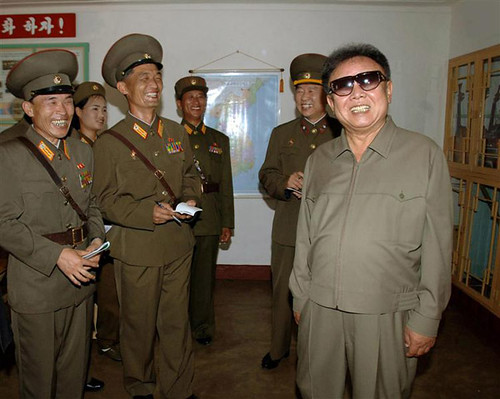
I believe the more pressing concern is about motivation - why did Kim Jong Il choose to attack a South Korean warship? I'm no expert on North Korea, but it seems to be an attempt to maintain his "irrational actor" status. If you accept that he is irrational, potent options - such as limited military strikes or more robust targeted sanctions - must be shelved under the notion that they may cause him to overreact, possibly with nuclear weapons. I think he is an eminently rational actor, interested solely in maintaining power and ensuring the succession of the family dynasty. If that is his goal, acting like a crazy person to keep the rest of the world off-balance is actually not so crazy. However, calling his bluff with surgical strikes is an extremely dangerous gamble with little upside.
The other key consideration is China. Beijing has been North Korea's most ardent supporter, and Chinese food aid nourishes many North Koreans. China fears the after-effects of a destabilizing regime change, with refugee flows across the border causing domestic upheaval. Kim Jong Il took a recent "secret" trip to China, and while the full contents of his conversations are not public it's safe to assume that the sinking of the Cheonan was on the agenda. As usual, China holds the balance of power and can influence the direction of future talks.
My prognosis: nothing. The Security Council may pass a few additional impotent sanctions, and South Korea will verbally lambaste the North, but no concrete action will be taken. Eventually the six-party talks will resume, with the status quo unchanged.
 Labels:

(A belated analysis of the Obama Administration’s Nuclear Posture Review, released on April 5, 2010)
The Obama Nuclear Posture Review is a profoundly political document whose main effect is diplomatic. It makes no major strategic changes to US nuclear doctrine, and the changes it does make are hedged by reservations. The document’s major departure from its predecessor, the Bush Administration’s 2002 NPR, is that of tone. As one reviewer noted, President Obama is no longer brandishing “a nuclear sword in every direction," which is the main legacy of this review.
First to the details. The review eschews a policy that the “sole use” of nuclear weapons is for deterrence, instead declaring that
“The fundamental role of U.S. nuclear weapons, which will continue as long as nuclear weapons exist, is to deter nuclear attack on the United States, our allies, and partners.The NPR sends a message to North Korea and Iran, declaring that
"the United States will not use or threaten to use nuclear weapons against non-nuclear weapons states that are party to the Nuclear Non-Proliferation Treaty and in compliance with their nuclear non-proliferation obligations."While the US will not use nuclear weapons to counter a chemical weapons attack, the review includes an exception for biological weapons, stating that
"the United States reserves the right to make any adjustment in the assurance that may be warranted by the evolution and proliferation of the biological weapons threat and U.S. capacities to counter that threat."Regarding the contentious issue of the deployment of tactical nuclear weapons in Europe, the NPR states that
"The United States will consult with our allies regarding the future basing of nuclear weapons in Europe, and is committed to making consensus decisions through NATO processes."In essence, although abandoning the bluster of the Bush Administration, the Obama Administration still maintains the right to use nuclear weapons outside of the context of a nuclear attack on the United States, and clearly describes North Korea and Iran as countries for which any assurances do not apply. Although this represents a shift in tone from the Bush years, its strategic impact is minimal. In fact, Stephen Walt has gone so far as to declare that “from a purely strategic perspective, this new statement is largely meaningless.”
Now to the politics. (more after the jump)
A few months back, we reported here at D&D on the crisis surrounding artillery barrages fired by North and South Korean forces into the highly contested maritime zone along the Northern Limit Line (NLL) in the Western Sea.
That escalation has continued, though our coverage of it has not. I have been hesitant to speculate on the swirling crisis around the suspicious sinking of the South Korean Corvette Cheonan on March 26, that claimed the lives of 46 sailors.
I was hesitant, mainly because there was little more than speculation around the causality of the Cheonan's sinking. Tonight, it appears that our wait may be over.
Whispers have been leaking from the South Korean defense establishment all day today, as the South Korean navy raised the sunken half of the Cheonan from the bottom of the Western Sea -- looking for answers.
Yonhap news has begun publishing, and then removing, some of these whispers:
"It is the military intelligence's assessment that the North attacked with a heavy torpedo."Chosun Ibo, a South Korean Daily, has run with the story.
The inference is that the North Koreans have made the first combat-effective use of their rumored suicide torpedo units. The units have been, to this point, mythic -- a boogie man brought out in the debriefings of high-value North Korean defectors, who describe a unit of 13 specially trained special forces members, and modified midget submarines. The Telegraph reports now that sources claim these men were responsible for the sinking of the Cheonan.

(more after the jump)
FINAL UPDATE at 1:18 AM EST -- 3:32 PM Korean Time
A bit of clarification and scope -- it appears that North Korea fired approximately 30 heavy artillery shells into the region around the NLL. They have also banned all maritime activity on their western coast. South Korea responded by firing 100 "warning shots" into the region.
UPDATE at 11:32 PM EST -- 1:32 PM Korean Time
As of now, it appears that there is all quiet in the NLL (northern limit line) in the Western Sea Zone. However, today's salvos of heavy artillery into the region are the most recent escalation involving the contested maritime border between North and South Korea. Here is the relevant timeline:
March 29, 2009 -- North Korea Declares 2 "No Sail/No Fly" Zones in the long-contested Western sea border between North and South Korea
November 10, 2009 -- A South Korean Patrol Ship opened fire on a North Korean naval vessel that had crossed the NLL (northern limit line), exchanging fire with that vessel, killing one North Korean sailor, wounding 3.
November 16, 2009 -- South Korea evacuates naval ships from the Western sea after detecting signs that North Korea had activated radar for surface to ship missiles deployed on the Ongjin Peninsula, Hwanghai Province, and had painted South Korean ships.
December 22, 2009 -- North Korea declared a "peacetime firing zone" along both sides of the NLL, to counter "the reckless military provocative manoeuvres by the warmongers in the South Korean military." warning of the deployment of both land based artillery and land to sea missiles.
January 25, 2010 -- North Korea unilaterally announced a shipping ban on both sides of the NLL, specifically in the region of east of the island of Baeknyeong and and west of the island of Daechyong, both locations of South Korean Naval and Marine Bases.
TODAY -- North Korea opened fire with land based artillery into the contested maritime border region, an action that was met with retaliatory "warning shots" fired by South Korean forces.
For D&D Snap Analysis of this new escalation of the Korean Maritime Crisis, read below!
UPDATE at 10:12 PM EST -- 12:12 PM Korean Time
As more news is rolling in, it appears that North Korea has fired multiple land based artillery rounds into the Western sea, a committal act that was met with South Korean retaliatory "warning shots" fired into the same maritime region. First reports from anonymous sources in the South Korean Defense Ministry are that there was no damage or casualties.
D&D SNAP ANALYSIS:
This event, coupled with the recent naval battle in the same region on the North/South Korean maritime border seems to suggest that North Korea has become increasingly sensitive about South Korean forces in the region, as both exchanges of fire have been instigated by North Korean forces reacting to South Korea's presence near the zone. On March 29, Pyongyang announced 2 "No Sail" zones in the Western sea, part of which included South Korean territorial waters -- suggesting that they may be preparing for possible missile tests in the area. Time will tell.
Check back soon for further news and analysis.
Previous Post Follows:
The AP and Yonhap News is reporting an exchange of heavy artillery fire between North and South Korean Forces along their disputed western sea border, the same region that witnessed the recent bloody gun battle between North and South Korean naval vessels.
The AP story can be found HERE
Check back soon for updates and analysis
Stay in the Loop!


 Posts
All Comments
Posts
All Comments
Our Favorite Blogs


.jpg)