When Robert Pape writes something on terrorism, I pay attention. He always adds something to the discussion, and usually it's something valuable. But his recent article on FP.com, "It's the Occupation, Stupid" delivers research results and leads the reader to an uncertain conclusion. His argument holds that terrorism, especially suicide terrorism, is motivated by foreign occupation. These findings, based on his research at the University of Chicago, make logical sense: of course people in an occupied territory resort to violence when all other means have been exhausted. His conclusion from this study, however, is problematic. Taking these findings to their logical end, Pape says
The research suggests that U.S. interests would be better served through a policy of offshore balancing.This is true, but interpreted incorrectly can lead to a dangerous isolationism. Pape is right that the War on Terror is self-defeating, and that having boots on the ground overseas can often be counterproductive. He is also right that occupying foreign territory provokes deadly blowback. But there are two important nuances to this argument:
1) Avoiding foreign occupation is not the same as withdrawing into isolation
2) Offshore balancing requires U.S. involvement and action in foreign countries, which could also instigate blowback.
First, it is important to recognize the difference between offshore balancing and isolationism. It is tempting to extrapolate from Pape's argument that retreating into "Fortress America" is the wisest course. But withdrawing from the world would not make America safer, and furthermore, in this global age, is impossible.
Secondly, offshore balancing implies U.S. power projection overseas and involvement in the affairs of other states, and that doing so is in the best interests of Washington. This could take the form of drone strikes, Special Operations raids, or even 1990's-style cruise missile attacks. But this involvement could have a similar effect as foreign occupation: motivating terrorists. This is a hole in Pape's data, and until further investigated remains a concern.
There is no question that Pape's overall point is correct: foreign occupation is a major driver of terrorism, and removing boots from the ground is preferable. But he would be wise to avoid leaving open the possibility of interpreting his findings to support isolationism.
 Labels:
Afghanistan,
Dave Reidy,
Iraq,
occupation,
Robert Pape,
suicide terrorism,
terrorism
|
Labels:
Afghanistan,
Dave Reidy,
Iraq,
occupation,
Robert Pape,
suicide terrorism,
terrorism
|
 2
comments
2
comments
Recently announced plans by the Afghan government for reconciliation and reintegration with the Taliban have been described to me by Afghan colleagues as both the best and the last idea that remains for how to bring the bring the nine year war to a close. The international security forces (ISAF) and the Taliban have been locked in a pseudo stalemate since the insurgent revival in 2007. While ISAF forces are more than capable of forcibly driving the Taliban from almost any area of Afghanistan, such offenses have roughly the same effect as squeezing a balloon. The more pressure you apply in one area the greater their presence will expand in another. As international support for the war has waned, the Karzai government has come under immense pressure to negotiate with the nebulous Taliban leadership in order to provide its coalition allies with an honorable exit strategy. While such a plan might seem feasible from the perspective of those sitting in Washington and perhaps even Kabul, the realities of how the insurgency is structured outside the capital discredit any hope for a lasting reconciliation.
During the course of interviews I conducted this summer in Kabul with members of the Force Reintegration Cell (F-RIC) at ISAF HQ I was shocked to learn that their plans for Taliban reintegration were based entirely on misconceptions about how the insurgency operates. The strategy, as it was explained to me, is to reward communities, not fighters, for allowing their "saddened brothers" to come down from the mountains and rejoin society. There exists two major problems with this line of thinking. First of all, as anyone who has spent serious time in places like Kandahar and Helmand can tell you, the Taliban do not live in the mountains, the majority of the day to day insurgent fighters live in the very villages that they are intimidating. Furthermore, if only communities that contain former insurgents are being rewarded with development money, we are suddenly going to find ourselves with many more fighters than we ever thought existed. Villages that were never known to have a Taliban presence before will inevitably begin blowing up their own roads in order to prove that they are deserving of reintegration money.
Apart from the difficulties surrounding how to actually identify low level insurgents, the question remains as to with whom the Karzai government actually intends to negotiate. When they ruled over most of Afghanistan in the 90's the Taliban possessed a hierarchical structure centering around Mullah Mohammed Omar. However, since their fall from power in 2001 and their eventual escape to Pakistan, the Taliban has since become an ambiguous grouping of smaller factions centering around key Mujahideen personalities such as Gulbuddin Hekmatyar and Jalaluddin Haqqani. Rumors abound of the senior Taliban leadership having reconstituted itself in Quetta, however, scholars such as Hassan Abbas challenge the veracity of these claims and question what if any influence the Quetta Shura would even have over the rest of the Taliban factions should it actually exist.
It has recently been brought to my attention that as someone in their mid-twenties I am a member of what has been referred to as the millennial generation. We are a group of people who were raised in years of economic prosperity and tech bubbles, only to have our world views rocked by the tragic events of 9/11. We spent our college years being lied to about why the nation needed to go to war in Iraq, and we sat in shock as over 4,000 men and women our own age lost their lives in two wars. Finally, once we reached maturity and entered the workforce, we experienced first-hand the result of a previous generation overcome with greed, a generation that had had complete and undying faith in the infallible nature of the capitalist marketplace.
Some pundits have suggested that the millennial generation is set to become one of the most isolationist and financially cautious generations that America has ever produced. However, upon hearing this I suddenly remember that the people making such claims are in fact members of the very generation whose sheer ineptitude resulted in the very conditions that were supposed to have gotten me so depressed and jaded in the first place. To those who have already preemptively given up on us millennials I say to you why don't you forget about retiring and instead start earning again to pay China back for all that money you all so wisely borrowed from them. In the meantime we up-and-comers will attempt to shift through the ashes of our once economically strong and internationally respected country.
I contend that the events on 9/11 have had the exact opposite effects of isolationism. We millennials may just have easily been called the first globalized generation as we saw first hand the effect that 19 Arab hijackers, disgruntled with foreign policies we had never heard of, could have on all of our lives. Since that day the number of students studying Arabic and Middle Eastern culture has sky rocketed across American campuses. I recently met the daughter of a New York City firefighter from Queens who had just returned from studying in Cairo. When I asked her why she chose to study Arabic she told me that after her father saw the towers fall in person he was determined to have his kids understand how such a thing could have happened.
Yes, our generation is going to be much more skeptical of politicians as a result of having been flat out lied to and manipulated by the Bush administration over the Iraq War. But is skepticism when it comes to ones elected officials ever really a bad thing? One thing I will say though is that the only way to truly keep one's government in check is to have a population willing to educate themselves on the issues. I appeal to all of my fellow twenty somethings to abandon all of the pied pipers parading their uneducated opinions across cable tv and recognize what our parents have not, that not everything calling itself news is really news. Would you watch FOX if it was renamed APE (American Propaganda/Entertainment)? I didnt think so. We must all recognize the fact that there is a difference between being informed and being educated. Watching the "news" endlessly all day might give you insight into what is happening in the world, but these shows will rarely tell you WHY they are happening. Those answers can simply only come from reading and independent investigation.
Our generation has the hard task of having to understand a very complicated world in its entirety. The policymakers of tomorrow will need to have the foresight to understand what unrest in places like Kazakhstan is going to do to the global energy markets and in turn how this will effect Saudi Arabia's relationship with its Arab neighbors. Previous generations of leaders felt secure that all they needed to leave college knowing about was the Soviet Union and the policy of deterrence. Maybe some of them even learned Russian in an attempt to be the best. Fast forward to today where members of the millennial generation are fighting to win a war in Afghanistan, a country where five languages are spoken and two (Dari and Pashtu) are vital to successfully completing the mission.
A final thought on whether the millennial generation is more or less likely to engage in military operations abroad in the wake of the wars in Iraq and Afghanistan. The next generation of military leadership that have just begun to take the reigns are the men and women who have spent the last nine years making their bones effectively making strategies like Counterinsurgency work. They see the importance of getting involved in countries like Yemen before they become safe havens for terrorists. Will be be doing nation building along the lines of Afghanistan and Iraq? Certainly not, but that does not mean that we will not seek to have a presence. If anything, it was the previous generation of cold warriors in the military who were so scarred by their experience in Vietnam that kept us from getting involved in places likes Afghanistan before they became a problem.
The road ahead will not be an easy one for the millennial generation, but I am secure in the fact that the series of blunders that we have been witness to over the past decade will serve to make us, the next generation of leaders, more cognoscente of the world in which we live. While we may not be as optimistic about the future as the baby boomers who came before us, I truly believe that it is the realism of the millennial generation that will one day return America to the pinnacle of international esteem.

One of the major revelations to come out of the 92,000 previously classified documents recently released by wikileaks is that apparently the Taliban have on several occasions fired at U.S aircraft using surface to air missiles better known as MANPADS (Man Portable Air Defense Systems). The media has seized upon this story as yet another government blunder since after all wasn't it the U.S. government who originally supplied the Mujahideen with stinger missiles back in the 80's when they were fighting the Soviets? However, a closer examination of the specs on these stingers leads one to a far different and perhaps more dangerous conclusion; that Pakistan has begun to supply the Taliban with their own surface to air missiles to use against U.S. forces.
I had often heard that there were several hundred stingers unaccounted for after the withdrawal of Soviet forces from Afghanistan and when I was there this summer I asked the crews of helicopters I was flying on why it was that we no longer considered these weapons a threat. According to weapons experts, the batteries on stinger missiles are good for one shot each and they must be changed out if the delivery system is to be used more than once. Furthermore, the average shelf life of unused batteries is only 4-5 years. Meaning that any stinger missiles given to the Mujahideen in the 80's would no longer be effective today. While it is not beyond the realm of contemplation that a skilled technician could jerry rig some sort of alternative battery for these devices, such skill is likely out of the range of the vast majority of Taliban. These weapons are however still capable of exploding, only the delivery device is deactivated. As such a great deal of the remaining stingers left over from the 80's have probably since been turned into IEDs.
The fact remains however that the Taliban are getting fully functioning MANPADS from somewhere, which in all likelihood have been constructed in the last 4-5 years. The most likely candidate is Pakistan which is both the traditional patron of the Taliban and has for the last twenty years been a manufacturer of their very own surface to air missile known as the Anza. The Anza has an effective range of up to 5000 meters and could certainly have been behind the downing of several US helicopters in recent years. In recent years, Pakistan has advertised the Anza series for export,displaying it at the International Defense Exhibition (IDEX) 2007 event in the UAE.
Worst case scenario: The Pakistani ISI is directly providing the Taliban with surface to air missiles
Best Case: Pakistan is irresponsibly selling MANPADS on the open market and they are ending up in the hands of the Taliban through a middleman
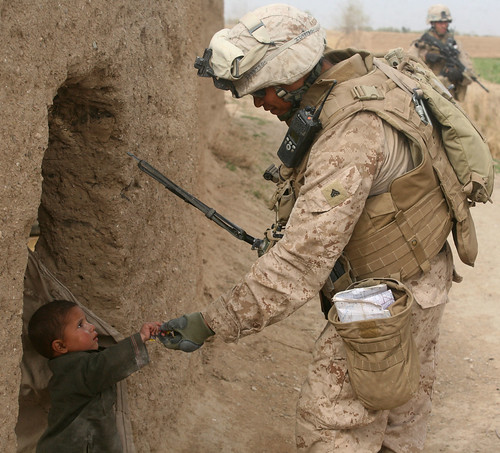
The always-superb Rajiv Chandrasekaran has a story in the Washington Post about progress in Afghanistan, comparing the lack of it in Marja (a "bleeding ulcer," as General McChrystal famously said) with the relative tranquility and prosperity of Nawa. Both hamlets are similar demographically and geographically, but while Marja continues to hemorrhage Nawa is creeping forward.
Both were stricken by the Taliban insurgency four years ago. And over the past year, both have been treated with America's new counterinsurgency formula: Each community has been flooded with U.S. Marines and Afghan security forces, at troop levels that meet or exceed what counterinsurgency theorists prescribe. Each has received a surge of cash and civilian experts in an effort to provide public services, rebuild infrastructure and dole out basic economic assistance. Each has been described as a priority by the central government in Kabul. So why did all this work in one but not the other?
 |
| Photo by Lance Cpl. Tommy Bellegarde |
Unfortunately, this is the wrong question. It rests on the assumption that the U.S. did something right in Nawa but something wrong in Marja, and the only thing to do is discover that error. At a deeper level, the assumption is that all events are conclusively influenced by U.S. policy - we can do it right or do it wrong, but ultimately we are the ones determining the outcome. I find this idea troubling. Accepting that the U.S. military is the decisive factor in the near-term future in Afghanistan means neglecting local relations and politics, national governance (or the lack thereof), and a host of other factors, not the least of which is the most fundamental of all military strategy - the enemy gets a vote.
Chandrasekaran almost hits on this point, but quickly loses the thread:
But the residents also emphasized that the Taliban fighters left of their own accord. "They chose to flee from here," said one shopkeeper. "They drove away as soon as the Marines arrived."In other words, perhaps the success in Nawa was not the result of superior American tactics, but rather of a Taliban miscalculation. Their failure in Nawa may have been part of the reason the Taliban refused to flee Marja; an attempt to avoid repeating the mistake.
So what does this mean for U.S. operations in Afghanistan? It's a reminder that actors and events that are not part of the plan influence the outcome, sometimes decisively. As the Bush Administration learned in the aftermath of the fall of Baghdad, unplanned events occur and must be dealt with, even if that means discarding the original blueprint. COIN doctrine cannot be implemented according to any book, and the notion that there is a "right" way to do COIN which guarantees success is a fallacy. Perhaps General Petraeus has taken a similar lesson from recent events. He has reportedly decided to scrap the invasion Kandahar, calling the current plan "not an appropriate model." Kudos to P4 for making the right call, and hopefully this is only the first of many.
Labels:
Afghanistan,
COIN,
Dave Reidy,
General Petraeus,
governance,
insurgency,
Marjah,
Nawa,
Rajiv Chandrasekaran
|
1 comments
General David Petraeus took command of American and NATO troops in Afghanistan on Sunday.
Many are considering this change of command to be little more than a change in nameplates, as President Obama has made it clear that US and NATO policy in Afghanistan will not change with the removal of General McChrystal. As we at Demagogues and Dictators seek to provide multi-faceted analysis of issues, I thought the below image provided an excellent graphical evaluation of the situation (courtesy of Doctrine Man)
On a serious note, I do think that the transfer of command is significant, even with all parties involved professing fealty to the current strategy.
Why? Because personalities matter, even in war.
Anyone who has ever spent time in any office (or pretty much anywhere, for that matter) can tell you that individuals who don't get along find it difficult to work together. Even if the dysfunctional triangle of General McChrystal, Ambassador to Afghanistan Eikenberry, and AfPak Envoy Richard Holbrooke never led to any purposeful undermining, poor (or very bad) communication is disruptive on many levels. First, and foremost, it causes a breakdown in staff communication farther down the chain. Second, it makes it that much more difficult for the US military and the US civilian agencies to understand what the other requires, something that is already difficult in the most hospitable of conditions. Third, it forces the United States to show a divided front in Afghanistan, and to all of the myriad actors important in the conflict (Pakistan, India, Russia, NATO, etc.).
Effective communication won't fix anything overnight, but they do improve ISAF's chances. In the jargon of the social sciences (I know, I can't resist), effective communication between civilian and military actors doesn't provide the permissive conditions for a successful counterinsurgency campaign, but they almost certainly are a necessary condition.
I don't know if General Petraeus will be able to work effectively with Ambassadors Eikenberry and Holbrooke, but I know that General McChrystal couldn't. That alone is reason for some hope.
Kabul, Afghanistan
The bottom line of what has happened to General McChrystal is that he was betrayed by his aides, who were supposed to be the ones protecting him from this sort of thing. The reporter from Rolling Stone was supposed to have two weeks of access to the staff, but because of the Iceland volcano and the resultant ash cloud he ended up getting stuck with McChrystal's team for a month. During that time the staff essentially "went native" with the reporter and started speaking too freely. If you read the article, all the bad stuff is said by McChrystal's aides, who imply that they are expressing the boss' feelings.
The rumor mill here in country speculates that perhaps McChrystal wanted out and this was how he decided to do it. But that is quite ridiculous, since there is really no bigger disgrace for a military man than to be fired by the Commander-in-Chief. While I understand the political reasons for why Obama removed McChrystal, I think a major blow has been struck to the effort here in Afghanistan. As we speak, instead of concentrating on the fight at a time of year that is the most kinetic we have seen in the past 9 years, the entirety of command is either packing their shit in boxes (as its not just the boss who gets fired but his whole staff) or preparing several weeks worth of briefs for Petraeus when he gets here.
Here in Afghanistan the talk in the hallways and cafeterias has been dominated by discussions of what will happen when "the boss" meets with President Obama tomorrow at the White House. There is no question that General McChrystal will offer to resign as a result of comments made by him and his aides to free lance journalist Michael Hastings author of the controversial Runaway General article in Rolling stone. When I initially heard murmuring about this article two days ago I assumed that the comments contained within were a strategic move on the part of General McCrystal and his staff to have their voices heard in order to pressure Congress and the Obama administration to stop playing politics with his war. After conducting more than 50 interviews with experienced military professionals here in Afghanistan, I can tell you first hand that many commanders here echo McCyrstal's point that they are being asked to sell an unwinable position. Setting a deadline of July 2011 for the start of a withdrawal essentially cuts counterinsurgency strategy off at the knees. However, now having read the Rolling Stone article, it is clear that General McChrystal and his staff went native with this reporter, letting their guard down too much to someone who was not to be trusted.
General McChrystal is obviously not the superman that the media had made him out to be. He is a man who has often blundered when it comes to off the cuff remarks to the media. He is however the exact person that America needs running the war in Afghanistan. Counterinsurgency doctrine is a relatively new introduction to Afghanistan and there are still many commanders who who do not buy into it. It will take a known warrior like McChrystal, who has more than his fair share of blood on his hands from his days running the Joint Special Operations Command in Iraq, to convince the most stubborn hold out here that we cannot kill our way out of Afghanistan. Besides his credibility amongst the majority of the troops here in Afghanistan, McChrystal is the only American that President Karzai is known to actually like in the whole country. The Rolling Stone article wrongly depicts General McChrystal as having stolen the diplomatic playbook for Afghanistan away from Ambassadors Eikenberry and Holbrooke. However, the plain fact of the matter is that both those men have publicly questioned Karzai's ability to lead and as a result he does not want to work with them.
The Western media has apparently flipped the switch on its collective brain and has begun incorrectly comparing General McCrystal to General MacArther, the commander of U.S. forces on the Korean Peninsula in 1951 who was subsequently fired by General Truman for insubordination. General McCystal is guilty of poor judgment obviously but has come no where close to committing insubordination. General MacArthur on the other hand flat out refused to follow several of President Truman's direct orders and was in fact secretly negotiating with influential congressman behind the Presidents back in order to gain approval for the escalation of the Korean War. Had MacArthur not been removed from his command the Korean War may very likely have gone nuclear. General McCrystal has disobeyed no direct orders nor has he sought to subvert President Obama's influence and thus has not committed insubordination.
If I was a betting man, I would bet conservatively on General McChrystal retaining his position as commander of ISAF, however, he is likely to be stripped of the majority of this diplomatic portfolio which will surely be given to Ambassador Eikenberry who will likely become the public face of the war as General McChrystal is ordered to retreat to the background.
 I've been following the scandal surrounding the remarks of General Stanley McChrystal fairly closely and have a few thoughts to add to the discussion kicked off by Jeff. I'll leave the decision of whether to sack McChrystal to the President, who said today he will make the opinion based on "how [he] can make sure that we have a strategy that justifies the enormous courage and sacrifice that those men and women are making [in Afghanistan]," but I don't think that the issue is the same kind of Rubicon-crossing challenge to the chain of command that Jeff implies in his post.
First, a few misunderstandings bear some brief analysis:
1) General McChrystal will almost certainly offer to resign, but President Obama's acceptance is far from certain.
2) General McChrystal is not new to the media. With fellowship stays at Harvard's Kennedy School of Government and the Council on Foreign Relations, as well as briefing the press during the Iraq invasion as the Vice Director for Operations on the Joint Staff, McChrystal should know the media quite well.
3) The vast majority of the quotes came from unsourced aides of McChrystal, not the general himself. TPM has a good summary of the most damning quotes from McChrystal's "Team America." This doesn't excuse their comments, or those made by McChrystal himself, but the Rolling Stone story wasn't just a profanity-laced interview by McChrystal, as some have made it out to be.
3-a) It is okay to vent and blow off steam, even regarding one's superiors, in a high-stress environment like Afghanistan. Doing so is natural, healthy, and far from an offense against the political order or the UCMJ. But that only applies when one does so privately. When you do so on the record to a reporter, no excuses apply.
Simply put, if the President is to fire his commander in Afghanistan, it should be for gross negligence, not purposeful insubordination. General McChrystal showed extremely poor political judgement in allowing the Rolling Stone reporter close access and allowing his staff to vent their frustrations on the record. Some might argue that McChrystal's job as a military commander is not to be political, but I don't think that argument is very strong when you're in a Senate-confirmed position leading the highly visible campaign in Afghanistan.
Of course this latest kerfluffle comes after a similar public disagreement last fall, when McChrystal was publicly chided for contravening his superiors during the President's Afghanistan Policy Review. In the end, President Obama's decision depends on whether he gives McChrystal a second (or fourth, depending on your perspective) chance. We'll see tomorrow.
Gen. Stanley McChrystal is ISAF Commander no longer -- at least that's what an unnamed TIME source is reporting.
If he hadn't resigned willingly, he should have been fired. If he resigned under pressure, he got off light. (For those of you living in a cave somewhere, go check out Rolling Stone.)
This morning Gen. Stanley McChrystal was flying home -- past the point of no return. But unlike in 49 BC, this time Caesar's army stayed at the front. The comparisons are flying fast and loose out here in the blogosphere, but whether the new crisis between Pres. Obama and his Afghan commander is the modern parallel of McArthur and Truman seems less important that what has actually happened in the past 24 hours.
Sure, it is satisfying (and required) to berate the General's apparent disdain for things like chain of command and those who disagree with him.
It is fitting to point out that for a special forces guy, McChrystal sure seems to love the media.
It is infuriating that for the second time in a year he has fundamentally challenged the authority of both the SecDef and POTUS in a very public way.
And he should be (and now is) gone.
While, according to this profile, he is apparently no stranger to bad romance; why McChrystal chose to deliver his resignation letter in the Lady Gaga edition of RS is a question for other pundits, the real question, in my mind, is: what now?
ISAF is without a commander, and after a year of taking body punches from the political right on his war decision making, President Obama and Secretary Gates can ill afford a lengthy interview process to pick his successor.
The pick, however...
The US military is buying Russian-made Mi-17 helicopters in order to equip the Afghan National Army Air Corps, and Congress is not happy about it.
The Washington Post reports:
In a turnabout from the Cold War, when the CIA gave Stinger missiles to Afghan rebels to shoot down Soviet helicopters, the Pentagon has spent $648 million to buy or refurbish 31 Russian Mi-17 transport helicopters for the Afghan National Army Air Corps. The Defense Department is seeking to buy 10 more of the Mi-17s next year, and had planned to buy dozens more over the next decade.So what's wrong with buying American helicopters to equip the Afghans?
The spectacle of using U.S. taxpayer dollars to buy Russian military products is proving a difficult sell in Congress. Some legislators say that the Pentagon never considered alternatives to the Mi-17, an aircraft it purchased for use in Iraq and Pakistan, and that a lack of competition has enabled Russian defense contractors to gouge on prices.
The most likely alternative candidates, the UH-60 Black Hawk or the CH-47 Chinook, have unit costs of between $10-$15 million and $10-$24 million, respectively. These costs track closely with the $15 million per unit the US government is paying for the Mi-17s. The American aircraft, however, are significantly more complicated than the Russian models - they lack "amenities" like GPS - which would drastically increase maintenance costs. With the goal of creating an Afghan air corps that can operate independently of US support, keeping future maintenance costs at a minimum can't be too far from the minds of US officials.

Most importantly, the Mi-17 works well in Afghanistan. First, Afghan pilots, to the extent that they have flight experience, have it with the Russian aircraft. This fact significantly lowers the learning curve of the new Afghan air corps, accelerating the development of Afghanistan's own armed forces. Second, the Mi-17 is described by US officials as "well-suited for navigating the altitudes of the Hindu Kush mountains, as well as Afghanistan's desert terrain."
"Buy American" is a worthy goal in the abstract, especially when times are tough, but the military's decision seems based on realities on the ground. Congress, led on this issue by Senator Chris Dodd of Connecticut and Senator Richard Shelby of Alabama, has a legitimate oversight role to make sure the military acts as a good steward of tax dollars, but can't lose sight of the larger picture. Winning the war in Afghanistan is more important than steering more contracts to a particular state - the UH-60 Black Hawk is produced by Sikorsky in Stratford, Connecticut.
UPDATE: Apparently my unit cost research was a bit off - the Mi-17 is actually much less expensive than the Black Hawk. The Thai Royal Army recently opted for purchasing three Mi-17s for the price of one UH-60.

On Monday, the New York Times reported on a Defense Department memo claiming that under Afghanistan's hard terrain lays nearly a $1 trillion in mineral deposits. These minerals include large veins of iron, copper, cobalt, gold and lithium a vital component of computer batteries. But the reality of this story is that it is more of a propaganda campaign or "information operation" than it is real news. Yes it is true that these minerals do exist in Afghanistan but it is by no means news. The U.S. Geological survey made the discovery back in 2007. However, the U.S. government is pushing the story now because the coalition here has been rocked by some particularly bad press here the past week (Ironically from the New York Times. This causes me to wonder if the Times is attempting to buy its way back into the good graces of the Embassy in Kabul.) The most damaging of this press was comments attributed to President Karzai about the West not being able to win in Afghanistan. This story is similar to ones that preceded the Iraq War when the Bush administration claimed that Iraq's oil wealth would pay for all the costs of reconstruction.
The reason why news of these vasts deposits is no need to celebrate is simple. The minerals are worthless unless you can actually get private companies to come in here and mine them. And with the security situation what it is that is not likely to happen any time soon. Afghanistan for instance would be a great country to run oil pipeline through, stretching from Kazakhstan and Uzbekistan through Afghanistan to Pakistan and then on to China as well. However, despite a great deal of effort on the part of a U.S. company called Unocal they were never able to negotiate enough treaties with all the tribes and Taliban to agree not to blow up the lines or siphon oil from them. The one country with a mining contract in Afghanistan right now is China which now owns the largest copper mine here. They don't care about their people dying so it works out well for them.
The Taliban can't really mine anything so we don't really have to worry about them getting this revenue as they simply arent organized enough not to mention the lliterate enough. Furthermore, from this map you can tell that the majority of the deposits are located in Northern, Western and Central Afghanistan, all areas where the Taliban is not strong. The Taliban makes the majority of their money through taxes, which they are pretty good at collecting. They front farmers the money to buy opium poppy seed. They then take a percentage of the farmers cut when he sells his product to the local drug lord. They then also tax the drug lord for the right to move his product through areas they control. It is very mafia like here both in the government and the black market.
The other really bad thing about all these mineral deposits being discovered is that its really just one more thing for the government here to exploit for bribes. The Chinese got their copper mine for a song simply by paying a few million to the right ministers. The mine itself is worth billions.
Apparently the nothing I discussed is actually substantial enough to draw attention from militants, who attacked the jirga proceedings yesterday. In a perverse way, this is a positive sign for Karzai. Empty talks pose no threat to the Taliban, and therefore are unlikely to prompt a response. But a concerted attack indicates that they view the jirga as a threat. In a strange way, this attack serves to increase the legitimacy and potential of Karzai's peace talks.
I remain skeptical that the Afghan government will actually implement any governance improvements, but having a peace jirga attacked by militants is a twisted victory in the public information war.
The BBC has a question: can a jirga without rebel leaders bring Afghanistan peace?
The answer, obviously, is a resounding no. Duh.
But if the jirga is a kind of peace conference, it is rather one sided. The insurgents' leaders are not there. Hizb-e-Islami, a small militant group which has sometimes fought with the Taliban, said the jirga was of "no importance". "The participants of the jirga are state favourites," said a statement released by the group. "They have no power of decision. It is only a consultative jirga - without any participation of the Mujahideen."So what's going on with Karzai? Clearly the U.S. is backing this initiative, but only tepidly. The Embassy released a statement of support, but the process hasn't been emphasized by any of the leading American policymakers, most notably McChrystal, Holbrooke, and Clinton. NATO is in favor as well, but let's be honest: this jirga is nothing but empty talk. Karzai and Co. can continue talking the talk of governance and reconciliation, but without clear results, real progress, changes will not be forthcoming. And if we've learned one thing about Karzai over the past (almost!) decade, it's that he is willing to talk nice, but not follow through.
To all our readers,
I must start off by apologizing for my long absence from the blog. Being a grad student, I was sidetracked with a large number of other papers and neglected my duties to this site.
Since then I have traveled to Afghanistan where I will be living for the next five weeks. Tomorrow I start the Counterinsurgency Leadership Course after which I will be traveling outside of Kabul observing information operations. Over the course of this time I hope to be able to provide you with a series of observations from the field.
My first such observation has to do with the complete lack of emphasis that Western media has put on exactly how international the force here really is. Today alone I have interacted with a dozen Australians, 5-6 French troops, some Italian army and police, and even an Irishman, not to mention the countless numbers of Nepalese and Mongolians who provide perimeter security for the majority of ISAF bases here.
This failure or reporting I believe stems from the emphasis that the Bush administration but on the fact that the invasion of Iraq was an international effort comprising troops from over forty members of the coalition of the willing. The number of international troops involved in that conflict were indeed laughable when compared to the 150,000 U.S. troops present in Iraq. While in Afghanistan, U.S. troops do account for more than fifty present of the force here, the level of international commitment to the Afghan conflict is clear to anyone who spends more than 15 minutes on any base here.
William Dalrymple is one of my favorite writers. City of Djinns, The Last Mughal, and White Mughals are among the finest sources available on the history of India, and From the Holy Mountain is an intellectual travelogue, blending the ancient and modern Middle East. But his recent op-ed in the New York Times, The Ghosts of Gandamak, is a disappointment. Dalrymple's sense of history and lively narrative ability are abundant, but his decision to abuse the tired trope about Afghanistan's invulnerability to conquest is a waste.

This story is sadly easy to believe. However, its relationship with the 1842 massacre is unclear. Dalrymple attempts to draw the lesson that military solutions alone are inadequate; if that's the status of the enlightened discourse about the Afghanistan campaign we are all in dire straits. That a political initiative is needed is apparently to all non-comatose observers, and although Dalrymple's advice to negotiate with the Taliban may be correct, it is in no way supported by his historical analogy.
I find it infuriating when a discussion of strategy in Afghanistan is hijacked by the fallacy that it is an inherently ungovernable zone. This position invokes the argument Seth Jones made when writing In the Graveyard of Empires: that would-be conquerors, from Alexander the Great through the British Empire, met their downfall in the mountains and valleys of Afghanistan at the hands of fiercely independent natives. The only lesson that can be learned from this teleological reading of history is to avoid Afghanistan at all costs, because forces sinister and free lurk to thwart the aspiring invader.
This notion, to be charitable, is rubbish. Afghanistan is difficult to govern because of its vast size and rugged terrain, but it is scarcely the only inhospitable ground on earth. It is no more or less difficult to control than any topographically similar area. Relying on this simplistic formulation to explain contemporary events dangerously obscures important factors and places undue emphasis on irrelevant areas.
There is value in Dalrymple, but it has nothing to do with the failings of the British or events of 1842. Instead, his tale should serve as another reminder of what we already know: no measure of success is possible in Afghanistan without good governance from Kabul; but all parties are falling drastically short in that metric. A failed 19th century British invasion holds no explanatory power nor relevant information about the continuing failure of President Hamid Karzai to provide basic services or tackle corruption, and that is the point which matters.
Beka Feathers
Demagogues and Dictators Afghanistan Parliamentary Analyst
As the situation in Afghanistan has deteriorated over the past two years, the public narrative has increasingly resembled a litany of failure: the central government is full of corrupt warlords who are tied to the drug trade, violate human rights with impunity, and are interested in the idea of governance only insofar as they can profit from it. The Afghan National Police are brutal, biased and uninterested in upholding the rule of law. Corrupt officials are becoming more prevalent than opium poppies. As a result, establishing legitimate government has become critical to success in all other areas of the mission in Afghanistan.
In all the fuss about the failures of the central government, however, a surprising success story is being overlooked. The Afghan National Assembly, the country’s highest representative institution, has begun, quietly, to govern. This is a surprise not only because the parliament has long been the forgotten stepchild of the Bonn Process, but also because Karzai and his international allies have done everything possible to prevent the parliament from becoming a strong check to the presidency.
Afghanistan is one of the most centralized countries in the world, and almost everything leads back to Karzai sooner or later. Consider: In Afghanistan, the President has the power to make the budget, pass decrees, hire governors and police chiefs, even to appoint teachers to local schools. Electoral law makes it almost impossible for political parties to operate by forbidding them to organize along any of the nationally recognized identity lines. The international community has largely supported Karzai’s attempts to further consolidate power in his person. The parliament, meanwhile, has lagged behind other government institutions in funding, resources, and capacity.
But starting this year, the parliament seems to have found its feet. Since January, it has challenged Karzai to appoint qualified ministers instead of warlords and cronies, rejected his attempted takeover of the independent Electoral Complaints Commission (the same body that found a third of his votes fraudulent in the election last fall), and refused to serve as a rubber stamp for decrees. In fact, it's been doing what so many outside observers have said is necessary to keep the government from collapsing entirely: serving as a legitimate, Afghan-led check on Karzai's administration.
Labels:
Afghan Elections,
Afghan Parliament,
Afghanistan,
corruption,
Guest,
Hamid Karzai
|
1 comments
Yesterday the Taliban killed the deputy mayor of Kandahar, Azizullah Yarmal. He was apparently was widely regarded as an honest and effective leader, unlike most of his colleagues. As Spencer Ackerman notes, this is clearly a setback to U.S. goals, as after the planned summer offensive in Kandahar providing good governance will require dedicated civil servants like Deputy Mayor Yarmal.
However, there is a silver lining. The method the Taliban used to kill the deputy mayor was quite brutal, even by their standards.
Deputy Mayor Azizullah Yarmal walked into a mosque in central Kandahar, turned toward Mecca and began to pray. As he reached the point where he and the others in the mosque knelt in unison and then bent forward to touch their foreheads to the ground, gunmen made their move, shooting him with a pistol, said Zalmy Ayoubi, a government spokesman.I haven't studied the issue in depth, but my understand is that assassinations in mosques are generally frowned upon. We know the Taliban is borrowing from the U.S. COIN manual, and killing a man while in the act of prayer generally serves to enrage, not please, the local population. This move smacks of desperation. If the Taliban in Kandahar must resort to mosque assassinations, I would hazard a guess that they are back on their heels and struggling to achieve their aims.
It will be interesting to follow reports from the area and see if this event does indeed represent a Taliban overreach, and, much like happened to Zarqawi in Iraq, the violence becomes too much for residents to bear.
 This week, US Forces withdrew from Afghanistan's Korengal Valley -- known more commonly to those who served there as "the valley of death". It is a story that has landed relatively quietly in the US media, and deserves much more attention.
US troops arrived in the Korengal in 2005 -- they moved in, claiming the high ground of the tiny, isolated valley, and prepared for an impossible mission. The strategy was for those soldiers to draw the fire and attention from Taliban and foreign fighters who sought to enter into Afghanistan from the Pakistani theater via the .8km-wide valley.
The goal was not to secure the valley, nor to block the valley's entrance. The goal was to tie up insurgents in a battle away from more populated regions of Afghanistan.
The goal was put quite frankly by the Washington Post:
"The troops were, in essence, bullet magnets. "Since 2005, over 40 US soldiers have been killed, hundreds wounded. The soldiers were met by daily small arms fire, ambushes, IED attacks, and mortar fire from the surrounding hills. Some of the fire came from Taliban, more from local insurgencies who sought to oppose the central government's expanded control over the remote valley -- filled with 5,000 fiercely independent Korengalis -- who speak their own language, and follow many of their own customs.
This year, a new command structure in Afghanistan has come to the conclusion that ISAF operations in Korengal run higher risks than rewards. The conclusion was that Capt. Mark Moretti's troops in the valley had not stumbled not into a hive of Taliban insurgency, but an internecine blood feud between Korengalis, who sought, above all, to be left to their own devices.
(more after the jump)
Today in the NY Times, former Assistant Secretary of Defense for International Affairs, Bing West wrote an Op-ed outlining his plan to save Afghanistan by circumventing Hamid Karzai and focusing on bringing governance to Afghanistan at the local level. Mr. West puts it out there that having a strong military actually running the country from behind the scenes may in fact be the best case scenario for Afghanistan. As he points out this would be situation like in Pakistan where instead of the country having a military, the military would have a country, but at least it would be more stable than the Afghanistan we find ourselves with today.
This argument is certainly interesting, and I do not argue with Mr. Bing that what we have now in Afghanistan is certainly not a democracy considering the blatant evidence that Hamid Karzai stole the election. However, his plan for a strong man government backed by the military has a very serious flaw. Bing West assumes that the Afghan National Army (ANA) is actually a capable force. While the ANA is rated higher than the Afghan National Police (ANP) in the sense that they aren't actually extorting locals or running drugs like the police. However, you have to think about who is actually joining the ANA. Afghan families and tribes are not going to let their best men leave their homes to support a government that they have no faith in. From what I have heard from U.S. troops who have gone on patrol with members of the ANA is that a lot of them are the "scrubs" of Afghan society.
My readers may find this short documentary clip of interest. Its a british video journalist who is on patrol with British and Afghan troops. As you can tell, the ANA shows no discipline and are in fact High in the middle of a firefight!
I leave you to draw your own conclusions about this.
And that's my fifty cents (inflation...)
Labels:
Afghan national army,
Afghanistan,
Bing West,
Hamid Karzai,
Jeremy White,
police
|
3
comments
Stay in the Loop!


 Posts
All Comments
Posts
All Comments
Our Favorite Blogs


.jpg)